Question 42 CEL02 - Chief Engineer - Limited (Alt)
What does section "C" of the circuit shown in the illustration function as? Illustration EL-0085
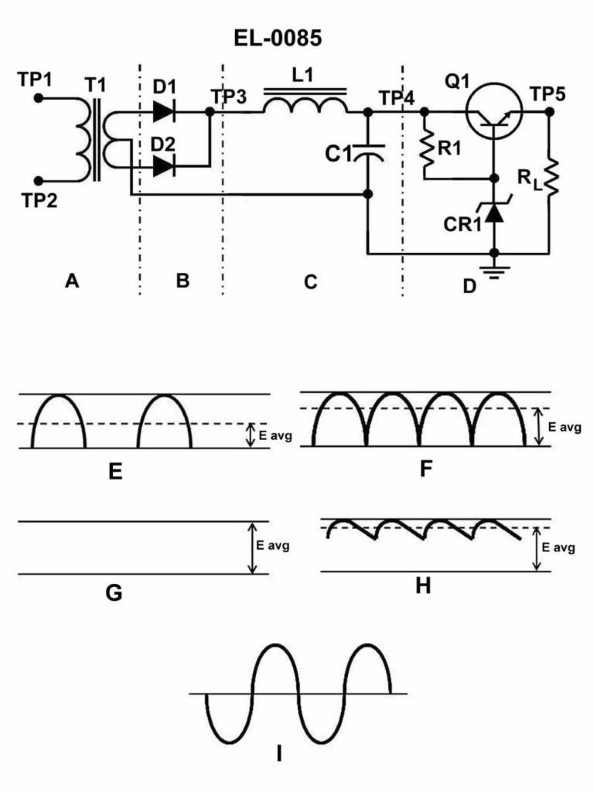
The Correct Answer is C ### Explanation for Option C (A Filter) Section C, positioned immediately after the rectifier stage (which converts AC to pulsating DC), almost universally functions as a **filter** in a DC power supply circuit. 1. **Function:** The rectifier output is not smooth DC but rather "pulsating DC," which contains significant voltage variation known as **ripple**. 2. **Mechanism:** The filter (typically a large capacitor or a capacitor-inductor network) stores energy during the peaks of the pulsating DC cycle and releases it during the troughs, thereby smoothing out the fluctuations. 3. **Result:** The output of the filter is a much steadier DC voltage suitable for use by sensitive electronic components or for input into a final voltage regulator stage. ### Explanations for Incorrect Options **A) a rectifier:** The rectifier function (conversion of AC voltage into pulsating DC voltage) is performed by diodes and occurs in the stage immediately preceding the filter (usually Section B). Section C only smooths the output of the rectifier, it does not perform the conversion itself. **B) a voltage transformer:** The voltage transformer is typically the first stage of a power supply (usually Section A), responsible for stepping down the high input AC voltage (e.g., 120V) to a lower AC voltage (e.g., 12V or 24V). **D) a voltage regulator:** A voltage regulator is used to maintain a constant, stable output voltage regardless of changes in the input voltage (from the filter) or changes in the load (current draw). While the regulator often follows the filter, the specific function of Section C is the smoothing (filtering) of ripple, not the precise stabilization of the final output voltage.
Pass Your Coast Guard Licensing Exams!
Study offline, track your progress, and simulate real exams with the Coast Guard Exams app