Question 7 CEL01 - Chief Engineer - Limited
Referring to the illustration, suppose after initiating the oil discharge mode, the oily-water separator fails to come out of the oil discharge mode in a timely fashion. Cracking open the upper sampling valve reveals the presence of oil exiting under positive pressure. What is most likely the cause? Illustration GS-0175
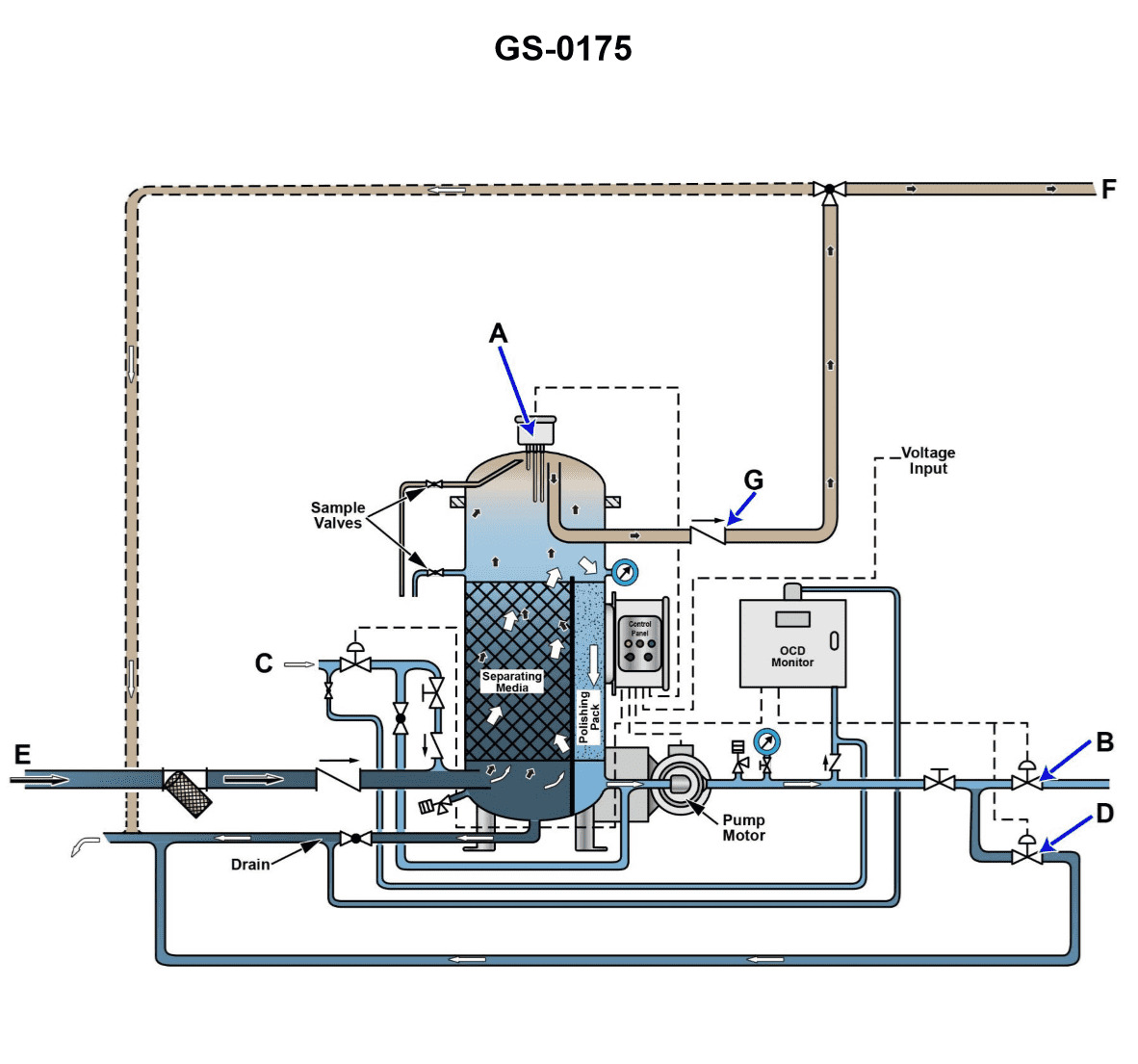
The Correct Answer is B **Explanation for B (Correct Option):** The scenario describes two key observations: 1. The oily-water separator (OWS) is stuck in the oil discharge mode (it fails to exit timely). 2. Cracking open the upper sampling valve reveals oil exiting under **positive pressure**. If the OWS initiates the oil discharge mode but the oil discharge check valve (or block valve) fails to open, the internal pressure generated by the separation process (often aided by clean water injection or displacement) has nowhere to release the accumulated oil. Since the system is trying to push the oil out, but the exit is blocked, the oil remains trapped inside the separator chamber, leading to a buildup of pressure (positive pressure) at the upper part of the chamber where the oil is concentrated. This trapped oil under pressure would immediately exit when the upper sampling valve is opened. Furthermore, because the oil hasn't discharged, the upper oil/water interface probe remains saturated with oil, preventing the system from automatically terminating the oil discharge cycle, causing it to run past its designated time. **Explanation of Incorrect Options:** * **A) The upper oil/water interface detection probe fails to end the oil discharge mode.** While the failure of this probe to detect the return of the water interface would cause the system to stay in the oil discharge mode too long (solving the first part of the observation), it doesn't explain the presence of **positive pressure** exiting the sampling valve. Pressure buildup is caused by a blocked discharge path, not a sensor failure. * **C) The clean water supply solenoid fails to open, and as a result provides no discharge pressure.** If the clean water supply fails to open, there would be no pressure generated to push the oil out of the separator. This would result in the OWS failing to discharge the oil, but there would be **no positive pressure** present at the upper sampling valve; if anything, the pressure would be ambient or lower. * **D) The lower oil/water interface detection probe fails to initiate the oil discharge mode.** The scenario specifically states the system is **in** the oil discharge mode ("after initiating the oil discharge mode..."). If the lower probe had failed, the system would likely not have entered the oil discharge mode in the first place, contradicting the premise of the question.
Pass Your Coast Guard Licensing Exams!
Study offline, track your progress, and simulate real exams with the Coast Guard Exams app