Question 50 1AE01 - First Assistant Engineer
If item "1" in the illustrated oily-water separator indicates an abnormally deep vacuum, which of the following conditions is the most probable cause? Illustration GS-0153
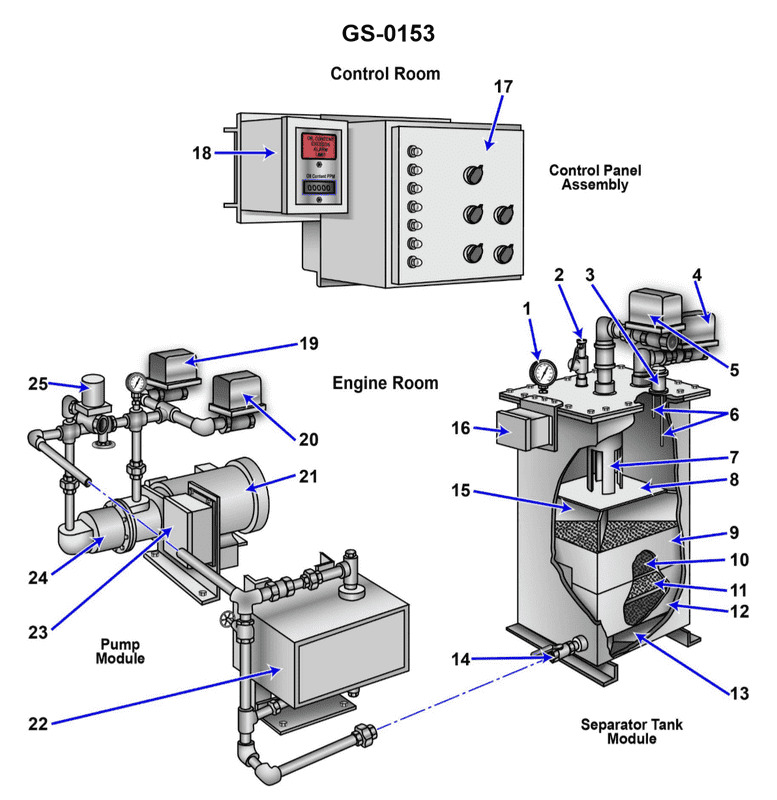
The Correct Answer is C ### 1. Explanation for Option C (Correct) **Option C: Suction line inlet strainer is obstructed.** An abnormally deep vacuum (very low pressure) on the suction side of a pump or separation system is the classic indicator of high resistance to flow or insufficient fluid supply (starvation). When the suction line inlet strainer becomes obstructed or clogged, the pump is attempting to pull its rated volume of fluid through a severely reduced opening. To overcome this restriction and maintain flow, the pump must pull significantly harder, increasing the required suction lift. This action results in a drastic drop in pressure within the suction chamber or line, which is registered as an **abnormally deep vacuum** at measurement point "1". ### 2. Explanation for Incorrect Options **Option A: Process water inlet valve, item "5", is open.** If the process water inlet valve is open, it ensures a continuous supply of fluid to the separator. This would typically stabilize or reduce the vacuum required (as the pump is well supplied). It would not cause an abnormally deep vacuum due to starvation. **Option B: Coalescer beds are severely fouled.** Fouling in the coalescer beds primarily causes a significant **pressure drop** *across* the beds themselves, and may reduce the overall flow rate, leading to discharge pump issues. While fouling creates resistance, the most common and direct cause of an abnormally deep vacuum registered at the primary suction point (Item 1) is a restriction occurring *before* the main chamber, such as an obstructed inlet strainer (C). **Option D: No problem exists as a high vacuum should be maintained in the chamber whose vacuum is to be measured.** While a certain degree of vacuum is necessary for proper operation in many separators, the term "abnormally deep" implies a pressure reading that is outside the normal, safe operating parameters. An abnormally deep vacuum indicates a performance issue, such as dangerous suction line restriction or a high risk of pump cavitation, and is definitely a problem that requires immediate attention.
Pass Your Coast Guard Licensing Exams!
Study offline, track your progress, and simulate real exams with the Coast Guard Exams app