Question 9 1AE01 - First Assistant Engineer
A high reading is indicated at the salinity cells labeled "SC1", "SC2", and "SC3" shown in the illustration. This is probably the result of which of the following? Illustration GS-0053
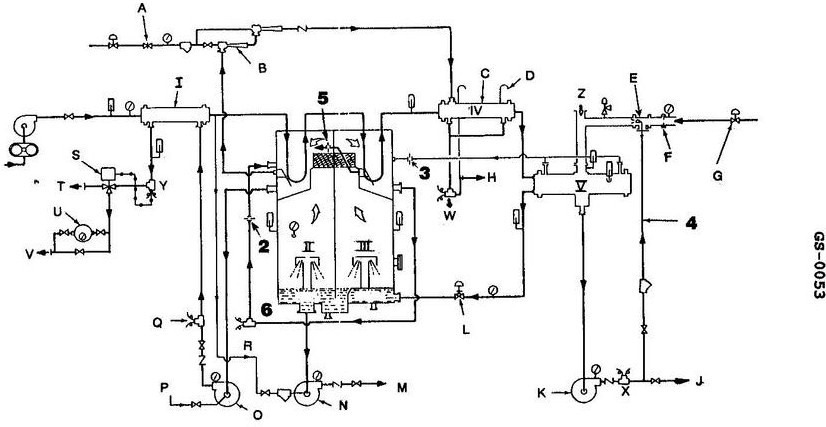
The Correct Answer is D **Explanation for Option D (Correct):** Option D, "carryover from 'FC1'", is the probable cause for a high reading at all three salinity cells (SC1, SC2, and SC3). In standard boiler/steam system diagrams (which this illustration GS-0053 likely depicts, focusing on feedwater conditioning or steam generation), FC1 typically represents a **Filter/Condensate tank** or **Feedwater Conditioner**. If chemical treatment (such as sodium sulfite or caustic soda) or dissolved solids are not being properly removed or are being overfed and carried over from the conditioning stage (FC1) into the main steam/water path, it will raise the conductivity (salinity) of the fluid. Since the salinity cells (SC1, SC2, SC3) are likely monitoring different stages of the condensate/feedwater loop, a widespread high reading at all three locations strongly suggests a systemic problem originating upstream, such as poor separation or chemical carryover from the primary conditioning source, FC1. **Explanation for Incorrect Options:** * **A) a leak in item "HX1"**: HX1 typically represents a Heat Exchanger. A leak in a heat exchanger would generally introduce *raw water* or cooling medium (like cooling tower water) into the system. While this *would* increase salinity, it usually causes localized high readings or massive changes if the leak is severe. It is less likely to cause a simultaneous, moderate high reading at three separate monitoring points throughout the system compared to a consistent chemical carryover issue. * **B) erosion of item "OR1"**: OR1 usually stands for an Orifice or Orifice Plate, used for flow measurement or restriction. Erosion of an orifice plate affects flow dynamics and pressure drop, but it does not introduce new contaminants or change the chemical composition of the fluid being measured. Therefore, it would not directly cause a high salinity reading. * **C) faulty cells at each location**: While possible for one cell to fail, it is highly improbable that three separate, independent salinity cells (SC1, SC2, and SC3) would simultaneously fail in a way that generates a false high reading at the exact time the observation is made. This is usually ruled out in favor of a single, upstream physical or chemical process failure (like carryover) that affects the monitored fluid.
Pass Your Coast Guard Licensing Exams!
Study offline, track your progress, and simulate real exams with the Coast Guard Exams app