Question 24 1AE01 - First Assistant Engineer
Referring to the illustrated motor ship freshwater cooling system drawing, what statement is true concerning the turbocharger bypass line associated with the jacket water cooling system? Illustration MO-0212
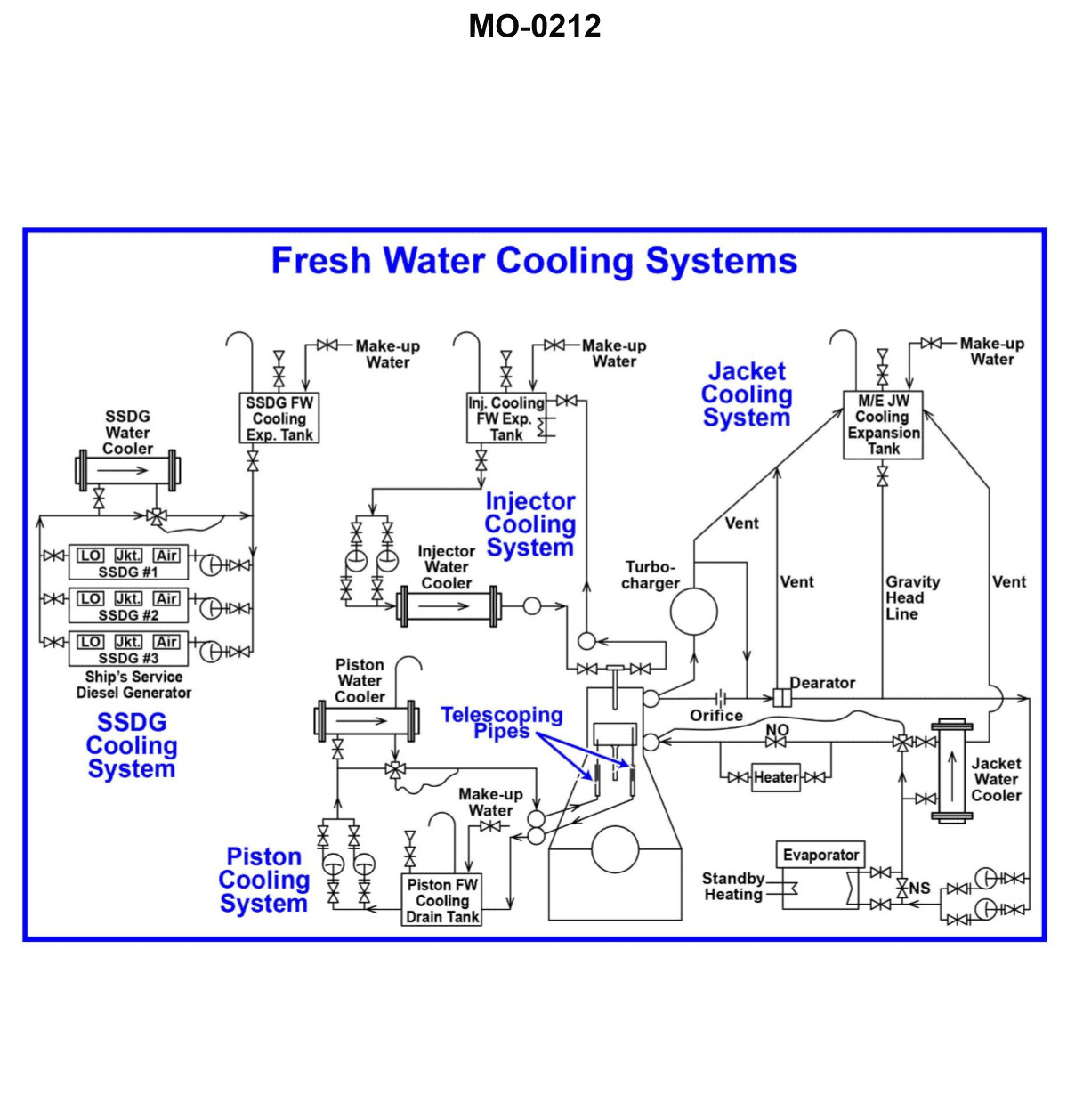
The Correct Answer is B **Explanation for Option B (Correct):** The turbocharger (TC) casing and associated components (like the bearings and sometimes the air cooler components) are cooled by the engine's jacket water system. However, the cooling requirements for the turbocharger are significantly less demanding than those of the main engine's combustion chamber jackets, cylinder heads, and liners. To ensure proper thermal control and prevent overcooling or inadequate circulation elsewhere, the system utilizes a bypass line containing a control orifice. This orifice is designed to restrict the flow of jacket water specifically to the turbocharger loop, ensuring that the TC receives a **lesser flow rate** necessary for its specific cooling duties compared to the much larger volume required by the main engine block itself. This proportional flow control is essential for maintaining optimal engine and TC operating temperatures. **Explanation of Why Other Options Are Incorrect:** * **A) The turbocharger cooling water bypass line with the control orifice works in conjunction with the deaerator to remove entrained air from the jacket water outlet.** * This is incorrect. While the jacket water system often includes deaeration features (like an expansion tank or deaerator), the primary function of the *turbocharger bypass line and orifice* is flow control and temperature regulation (cooling), not air removal. Air removal usually occurs via high-point vents or a dedicated deaeration tank connection from the highest points of the entire system. * **C) The turbocharger cooling water bypass line with the control orifice proportions the cooling water flow so that the turbocharger receives a greater flow rate of cooling water as compared to the main engine cooling water jackets.** * This is incorrect. The cooling load of the TC is minor compared to the main engine block. Sending a *greater* flow rate to the TC would be inefficient, potentially divert necessary flow away from the critical engine components, and cause excessive temperature drop in the TC, which is undesirable for efficient operation. * **D) The turbocharger cooling water bypass line with the control orifice proportions the cooling water flow so that the turbocharger receives the same flow rate of cooling water as does the main engine cooling water jackets.** * This is incorrect. The main engine jackets encompass the vast majority of the cooling volume and surface area. Supplying the TC with the *same* flow rate as the entire engine jacket system is physically impractical and unnecessary due to the large disparity in cooling load and volume between the two components. The orifice specifically restricts flow to ensure a smaller, targeted flow rate (Option B).
Pass Your Coast Guard Licensing Exams!
Study offline, track your progress, and simulate real exams with the Coast Guard Exams app