Question 206Electricity & Electronics - 1st Asst/Chief
70% to passAs shown in figure "A" of the illustration, under what conditions will the thyristor conduct? Illustration EL-0154
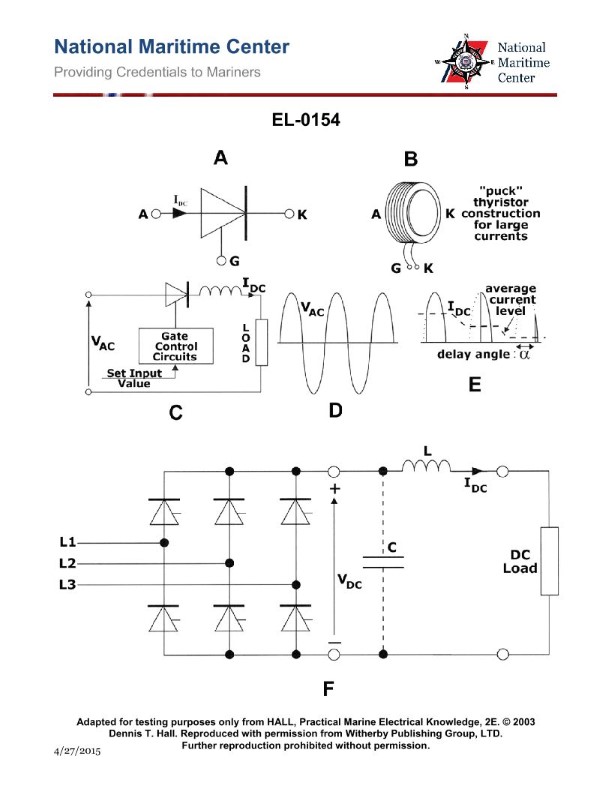
The correct answer is A) when the anode is more positive than the cathode and when the gate is briefly pulsed with a voltage more positive than the cathode. For a thyristor to conduct, two conditions must be met: 1) the anode must be more positive than the cathode, and 2) the gate must be briefly pulsed with a voltage more positive than the cathode. This triggers the thyristor to turn on and allow current to flow from the anode to the cathode. The other answer choices are incorrect because they describe conditions that would either prevent the thyristor from conducting (B and D) or require the gate to be pulsed with a negative voltage, which is not how a thyristor operates (C).
Ready to test your knowledge?
Take a Electricity & Electronics - 1st Asst/Chief Practice ExamPass Your Coast Guard Licensing Exams!
Study offline, track your progress, and simulate real exams with the Coast Guard Exams app