Question 32 UFIV02 - Assistant Engineer - UFIV
The diesel generators on the fishing industry seiner to which you are assigned are fitted with a charge air system as shown in the illustration. What statement is true concerning this type of charge air system? Illustration MO-0134
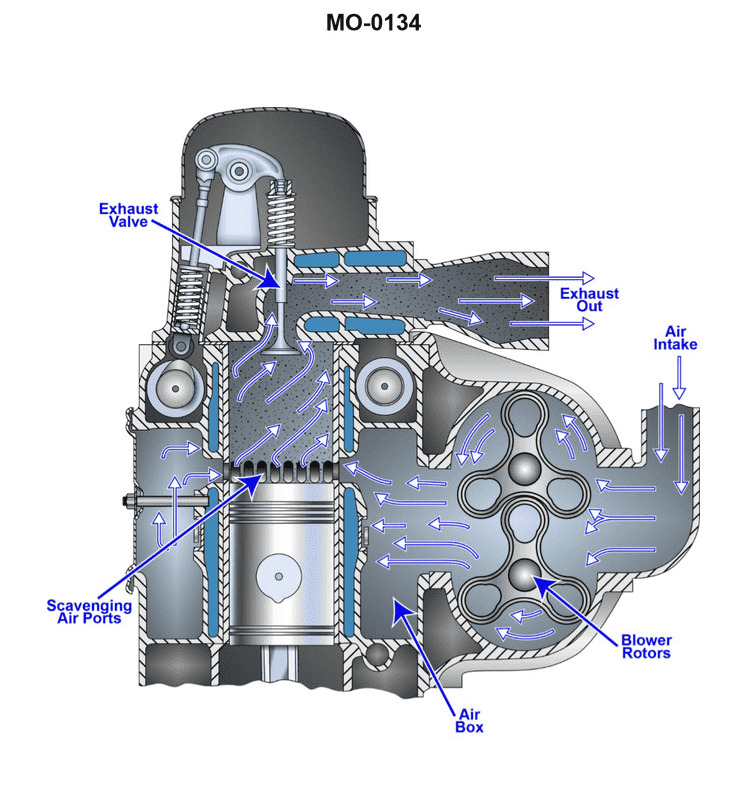
The Correct Answer is A ### Explanation of Correct Option (A) Option A states: "The scavenging blower is a positive displacement type, and the actual displacement is directly proportional to engine speed." 1. **Positive Displacement Type:** In diesel engines utilizing a charge air system (especially two-stroke engines, or older/medium-speed four-stroke engines using a dedicated scavenging blower alongside or instead of a turbocharger, like those commonly found in fishing vessel generators), the auxiliary blower (often a Roots blower) is typically used for scavenging and initial charging. A Roots blower is a **positive displacement** device. It traps a fixed volume of air in its pockets and forces it toward the outlet for every revolution. 2. **Displacement Proportional to Engine Speed:** Since the blower is mechanically coupled and driven directly by the engine (via gears or a belt), the rotational speed of the blower is directly linked to the engine RPM. Because it is a positive displacement device, the volume of air delivered per unit time (the actual displacement) is directly proportional to its rotational speed. Therefore, as the engine speed increases, the volume of air delivered by the scavenging blower increases proportionally. ### Explanation of Incorrect Options **B) The scavenging blower is a non-positive displacement type, and the actual displacement is directly proportional to engine speed.** * **Incorrect:** The scavenging blower used in this context (a Roots blower or similar mechanical blower) is a positive displacement device, not a non-positive displacement device (like a centrifugal blower or turbocharger compressor, which rely on velocity changes). **C) The scavenging blower is a positive displacement type, and the actual displacement is not directly proportional to engine speed.** * **Incorrect:** While the blower is correctly identified as positive displacement, the conclusion that the actual displacement is *not* directly proportional to engine speed is false. Since the blower is mechanically linked to the engine, its output speed (and thus its displacement/airflow) changes linearly with engine speed. **D) The scavenging blower is a non-positive displacement type, and the actual displacement is not directly proportional to engine speed.** * **Incorrect:** This option incorrectly identifies the blower type (it is positive displacement) and incorrectly characterizes the relationship between displacement and engine speed (it *is* directly proportional due to the mechanical drive linkage).
Pass Your Coast Guard Licensing Exams!
Study offline, track your progress, and simulate real exams with the Coast Guard Exams app