Question 29 UFIV01 - Chief Engineer - UFIV
The deck winch on your ship-handling tug is fitted with a Woodward SG Type governor, as shown in the illustration. In addition to variable governed speed setting, what other group of settings is built into this particular governor? Illustration MO-0157
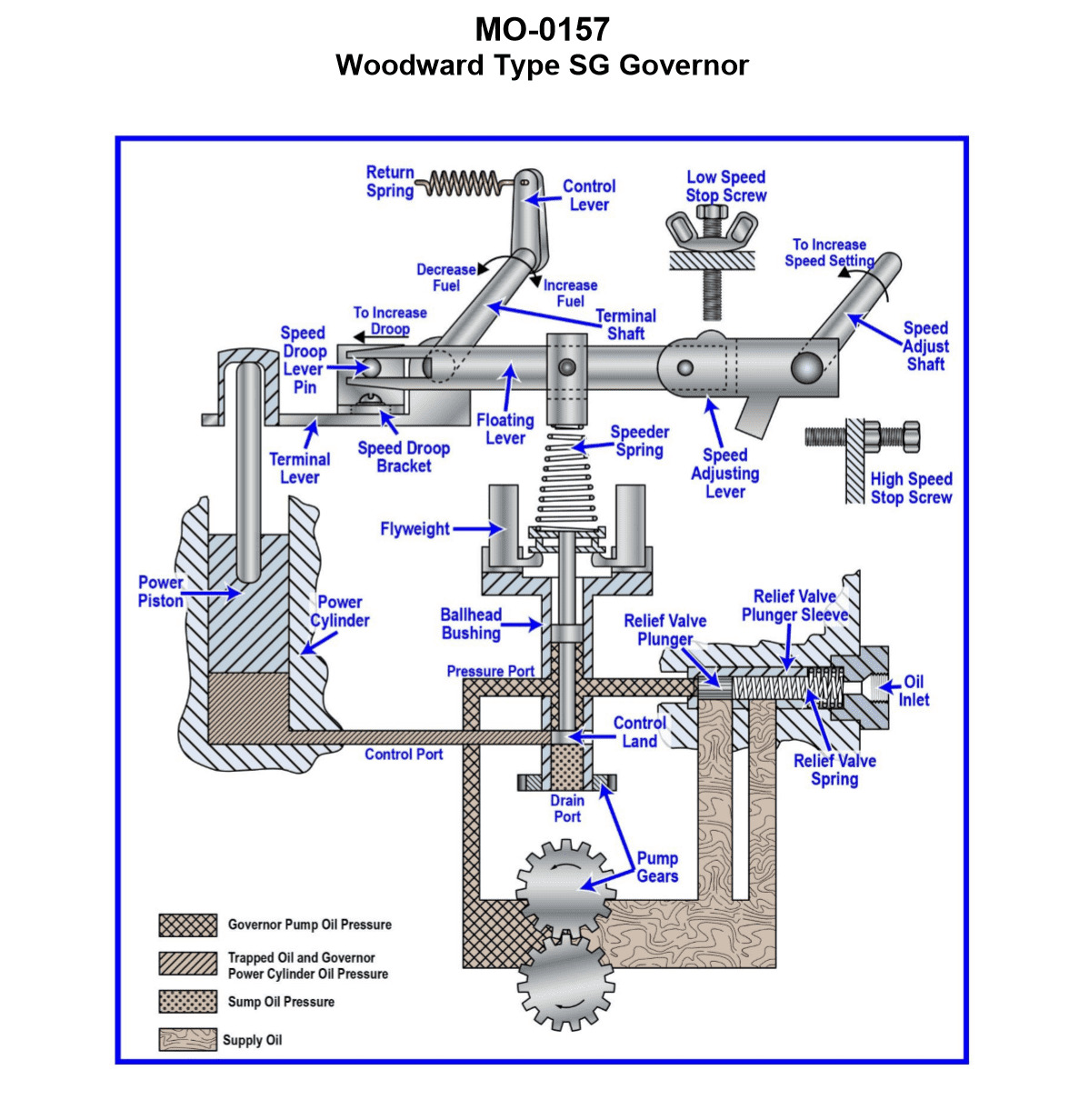
The Correct Answer is A ### 1. Explanation for Option A (Correct) The Woodward SG (Standard Governor) type is a **mechanical-hydraulic governor** often used for speed control on various engine applications, including winches on tugboats. While it fundamentally provides variable speed governing (the primary function), it typically incorporates adjustments that define the operating limits of the engine under governor control: * **Engine idle speed (minimum governed speed):** This sets the lowest stable speed the governor will maintain when the speed lever is at its minimum setting. This is essential for engine operation, especially during periods of no load or standby. * **Engine speed limit (maximum governed speed):** This sets the highest speed the governor will allow the engine to reach, regardless of the position of the speed lever (unless the speed lever is moved to an underspeed setting). This acts as an overspeed protection limit (though often a separate overspeed trip is used for emergency cutoff, the maximum speed stop is a key governor setting). These two settings (minimum and maximum speed stops/settings) are basic and standard adjustments built into the mechanical linkage or structure of the SG governor to define the operational range available to the operator, in addition to the operator-controlled speed setting (variable governed speed). ### 2. Explanation of Why Other Options Are Incorrect **B) Engine idle speed (minimum governed speed), engine load limit (maximum fuel delivery)** * While engine idle speed is correct, the **engine load limit (maximum fuel delivery)** is typically a separate mechanical stop (often called the "maximum fuel rack stop" or "torque limit") built into the engine's fuel pump linkage, *not* a primary adjustment of the standard SG governor head itself. Although the governor controls fuel delivery based on speed, defining the absolute physical maximum fuel rack position is usually an engine/pump setting, not an SG governor adjustment. **C) Engine load limit (maximum fuel delivery), engine speed limit (maximum governed speed)** * Maximum governed speed is correct. * Engine load limit (maximum fuel delivery) is incorrect for the reason stated above—it's usually an engine fuel system setting, not a primary built-in adjustment of the governor head linkage (like the min/max speed settings are). **D) Engine speed droop (load sharing adjustment), governor compensation (stability adjustment)** * While droop and compensation are critical adjustments on *all* hydraulic governors (including the SG) for stability and load sharing, they define the *quality* of the speed control (stability and responsiveness), not the *range* or *limits* of engine operation. * The question asks what *other group of settings* is built in besides the variable speed setting. Minimum and maximum speed stops define the fundamental operational limits required for the engine, whereas droop and compensation are fine-tuning adjustments for the dynamics of governing. The most fundamental physical limits built into the SG governor's structure are the minimum and maximum speed settings (Option A).
Pass Your Coast Guard Licensing Exams!
Study offline, track your progress, and simulate real exams with the Coast Guard Exams app