Question 6 RVR04 - Master or Mate of LT 200 GRT
BOTH INTERNATIONAL & INLAND Which of the following in illustration D086RR below represents the length of a vessel as defined by the Rules?
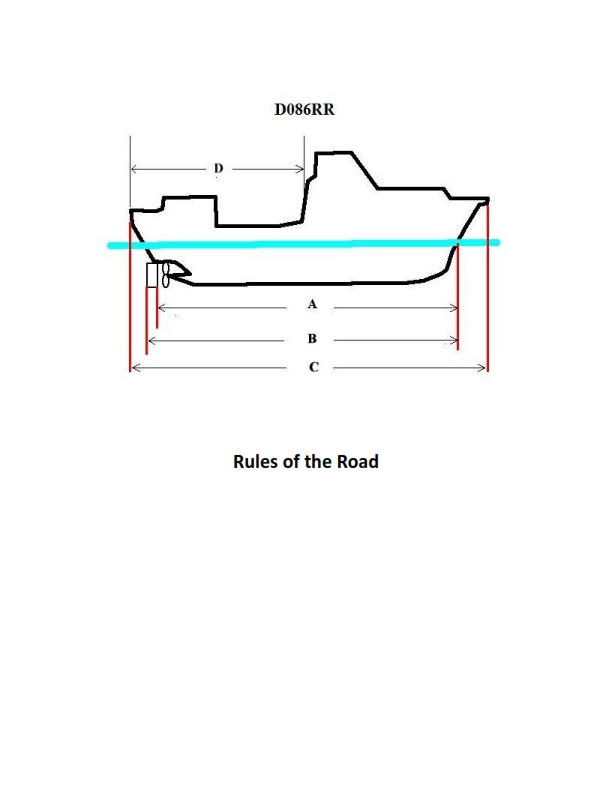
The Correct Answer is C. **Explanation for C:** Option C represents the length overall (LOA) of the vessel, which is the definition used for determining the application of various Rules concerning equipment, lights, shapes, and sound signals under the International Regulations for Preventing Collisions at Sea (COLREGs). The length of a vessel as defined by the Rules (specifically in relation to requirements like masthead lights, visibility, or whistle size) is measured from the foremost part of the hull to the aftermost part of the hull, including all fixed parts such as bowsprits, davits, or fixed fittings that extend the effective length of the vessel. In illustration D086RR, line C clearly spans the maximum physical extent of the vessel's hull. **Explanation for Incorrect Options:** * **A) A:** Option A typically represents the length of the waterline (LWL), which is the length of the vessel measured at the load waterline. While important for hydrostatic calculations, it is generally not the measure used to define the vessel's length for applying COLREGs requirements. * **B) B:** Option B appears to represent the length between perpendiculars (LBP). This is a technical measurement used primarily in naval architecture and shipbuilding, measured from the forward perpendicular (often the stem at the waterline) to the after perpendicular (often the sternpost or rudder stock axis). It excludes the full overhangs of the bow and stern and is therefore not the measure required by the Rules. * **D) D:** Option D represents the beam (breadth) of the vessel, which is the maximum width of the vessel. This measurement relates to the dimension across the vessel, not the dimension of the length.
Pass Your Coast Guard Licensing Exams!
Study offline, track your progress, and simulate real exams with the Coast Guard Exams app