Question 13 RVR04 - Master or Mate of LT 200 GRT
INLAND ONLY Two power-driven vessels are meeting in a narrow channel on the Great Lakes as shown in illustration D037RR below. Vessel "A" is downbound with a following current. Vessel "A" shall do which of the following?
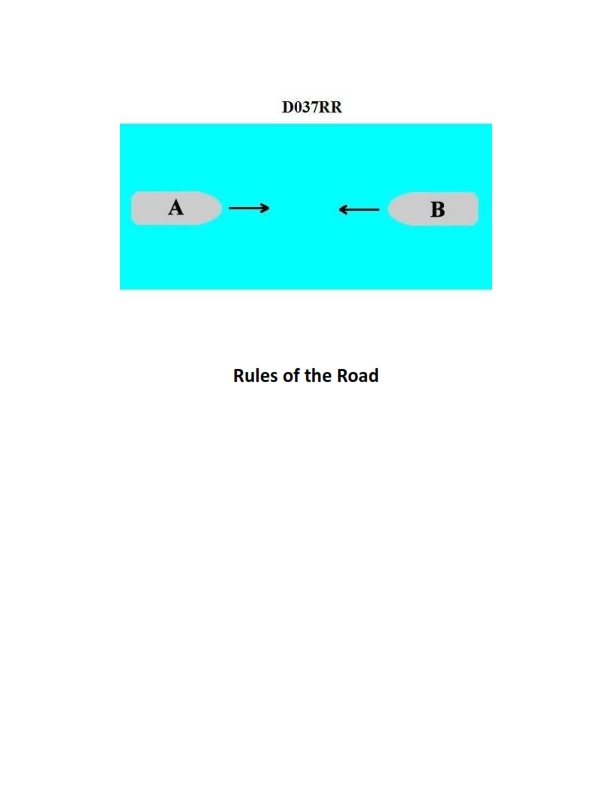
The Correct Answer is D ### 2. Explanation of why option D ("All of the above") is correct Vessel "A" is navigating downbound with a following current in a narrow channel on the Great Lakes. Under Inland Rule 9(a)(ii), which governs meeting situations in narrow channels on the Great Lakes, Western Rivers, and certain other waters, the vessel proceeding downbound with a following current (Vessel A) is granted specific privileges and responsibilities. * **Vessel A shall have the right of way (Option C is correct).** Rule 9(a)(ii) states that the downbound vessel proceeding with a following current shall have the right-of-way over the upbound vessel. * **Vessel A shall propose the manner of passage (Option A is correct).** Because Vessel A has the right-of-way, it is responsible for determining and communicating the preferred passing arrangement (port-to-port or starboard-to-starboard). * **Vessel A shall initiate the maneuvering signals (Option B is correct).** The proposal for passage must be communicated using the required maneuvering signals (Rule 34) (one short blast for port-to-port, two short blasts for starboard-to-starboard). Since Vessel A must perform all these actions—having the right of way, proposing the passage, and initiating the signals—**D (All of the above)** is the comprehensive correct answer. *** ### 3. Explanation of why the other options are individually incorrect Although options A, B, and C are all true statements regarding Vessel A's responsibilities, they are individually incorrect choices for a multiple-choice question where "All of the above" is an option: * **A) Propose the manner of passage:** While Vessel A must propose passage, this is only one part of the required procedure. Vessel A must also have the right-of-way and sound the corresponding signal. Therefore, A is incomplete. * **B) Initiate the maneuvering signals:** Vessel A must initiate the signals, but this action is the *means* by which the proposal is communicated, and it is based on the fact that Vessel A holds the right-of-way. It is not the complete answer encompassing the full legal requirement. * **C) Have the right of way:** Vessel A does have the right-of-way, but holding the right-of-way is a status granted by the rule; it is not the only action required. The rule requires the vessel with the right-of-way to actively propose the maneuver to the upbound vessel. Therefore, C is incomplete.
Pass Your Coast Guard Licensing Exams!
Study offline, track your progress, and simulate real exams with the Coast Guard Exams app