Question 43 RVR04 - Master or Mate of LT 200 GRT
INLAND ONLY Two power-driven vessels are meeting in the situation as shown in illustration D037RR below and will pass within 1/2 mile of each other. What does two short blasts from either vessel mean?
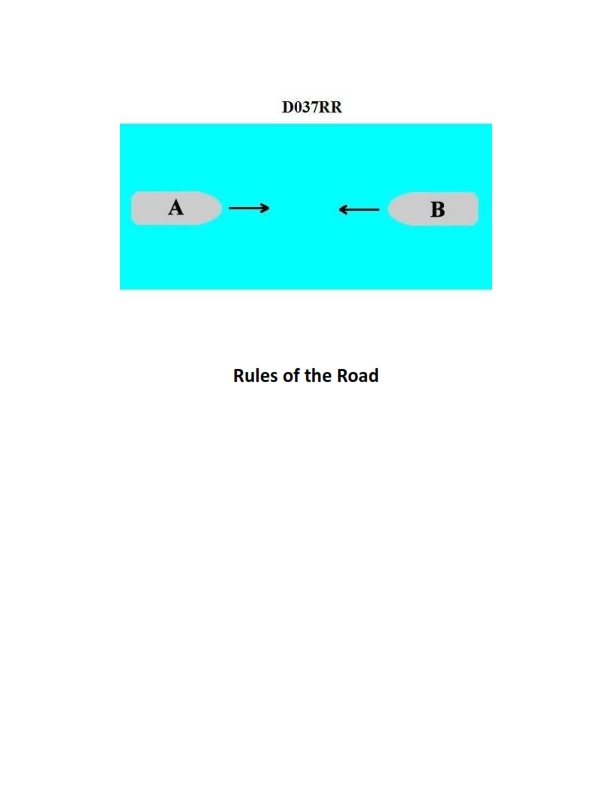
The Correct Answer is B **Explanation for B (Correct Answer):** The scenario specified is **"INLAND ONLY"** (referring to the U.S. Inland Rules of the Road). According to Rule 34(a)(i) of the Inland Rules, when vessels are in sight of one another and meeting or crossing, the signals used are signals of *intent*. * **Two short blasts** (• •) signifies: **"I intend to leave you on my starboard side."** This means the signaling vessel intends to alter course to port (left) to pass the other vessel. **Explanation for Incorrect Options:** * **A) "I am altering my course to port."** While two short blasts usually *results* in an alteration of course to port, the signal itself is defined as an indication of the *intended passing arrangement* ("I intend to leave you on my starboard side"), not merely the physical act of turning. In the Inland Rules, these intent signals are paired with specific passing arrangements. * **C) "I intend to leave you on my port side."** This is incorrect. The signal for intending to leave the other vessel on your port side is **one short blast** (•) in the Inland Rules (indicating the vessel intends to alter course to starboard). * **D) "I am altering my course to starboard."** This is incorrect. Altering course to starboard (right) corresponds to the intention to leave the other vessel on your port side, which is signaled by **one short blast** (•). Two short blasts indicate an alteration to port (left).
Pass Your Coast Guard Licensing Exams!
Study offline, track your progress, and simulate real exams with the Coast Guard Exams app