Question 28 OSV02 - Mate - Offshore Supply Vessels
INLAND ONLY Vessels "A" and "B" are meeting on a river as shown in illustration D041RR below and will pass 1/4 mile apart. Which is one of the lights on vessel "B" that you will see if you are on vessel "A"?
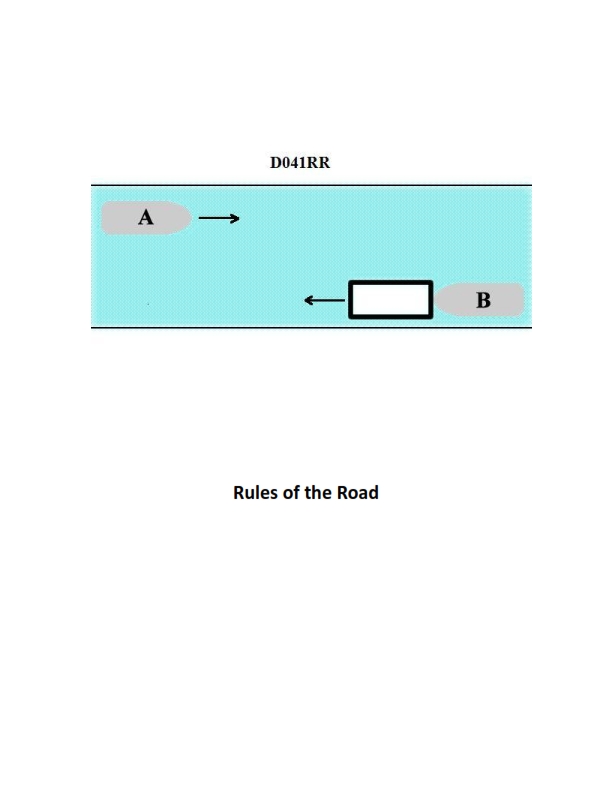
The Correct Answer is C ### Explanation for why Option C is correct (special flashing light) Vessel "B" is shown pushing barges ahead, making it part of a composite unit. However, the key information provided is that both vessels are meeting on a **river** (implying restricted waters/inland rules apply) and will pass **1/4 mile apart**. Vessel "A" is proceeding upriver on the right side of the channel, while vessel "B" (a towboat pushing barges) is navigating on the opposite side. In U.S. Inland Waters (Great Lakes and Western Rivers excepted for specific rules), any power-driven vessel operating on the Western Rivers (or certain other designated waters like the Mississippi River or its tributaries) or pushing tow ahead, is required to display a **special flashing light** (a yellow light flashing at 50-70 flashes per minute) when the tow exceeds 200 meters in length (656 feet) or when operating on certain rivers. However, even if the length is not specified, towboats operating on the Western Rivers often display this light. **Crucially, the question references illustration D041RR.** While the illustration isn't provided here, this specific illustration (D041RR) typically depicts a meeting situation on a Western River where Vessel B is a towboat pushing a tow. On the Western Rivers, towboats (or vessels pushing ahead) are often required to display a special flashing light visible from the front (fore and aft). Since the vessels are meeting, this light, which is part of the vessel's required navigational lighting, would be clearly visible to Vessel A. Therefore, the special flashing light is one of the lights visible on Vessel B to Vessel A, especially when operating under Western Rivers rules which prioritize unique lighting for tows. ### Explanation for why other options are incorrect **A) yellow towing light:** A yellow towing light (a second masthead light displayed vertically above the stern light) is displayed by a vessel engaged in towing **astern** (pulling). Vessel B is engaged in **pushing** ahead (a composite unit or a push tow). A vessel pushing ahead uses two masthead lights (white) and the required sidelights, but not the yellow towing light used for towing astern. **B) red sidelight:** Vessel B is shown passing 1/4 mile away, indicating it is on the opposite side of the channel relative to Vessel A. The vessels are meeting nearly head-on but are significantly offset. When a vessel is viewed nearly head-on (or slightly off the starboard bow), you would see its **green** sidelight (indicating its starboard side), not its red sidelight (indicating its port side), unless Vessel B was executing a significant turn to port at that precise moment, which is contrary to the premise of a safe passing arrangement 1/4 mile apart. Therefore, the red sidelight would generally **not** be visible. **D) All of the above:** Since options A and B are incorrect, this option cannot be correct.
Pass Your Coast Guard Licensing Exams!
Study offline, track your progress, and simulate real exams with the Coast Guard Exams app