Question 45 OSE02 - Assistant Engineer - OSV
The auxiliary engines on the offshore supply vessel to which you are assigned are fitted with Roots-blowers as shown in the illustration. What statement is true concerning the timing gears as shown in figure "A"? Illustration MO-0135
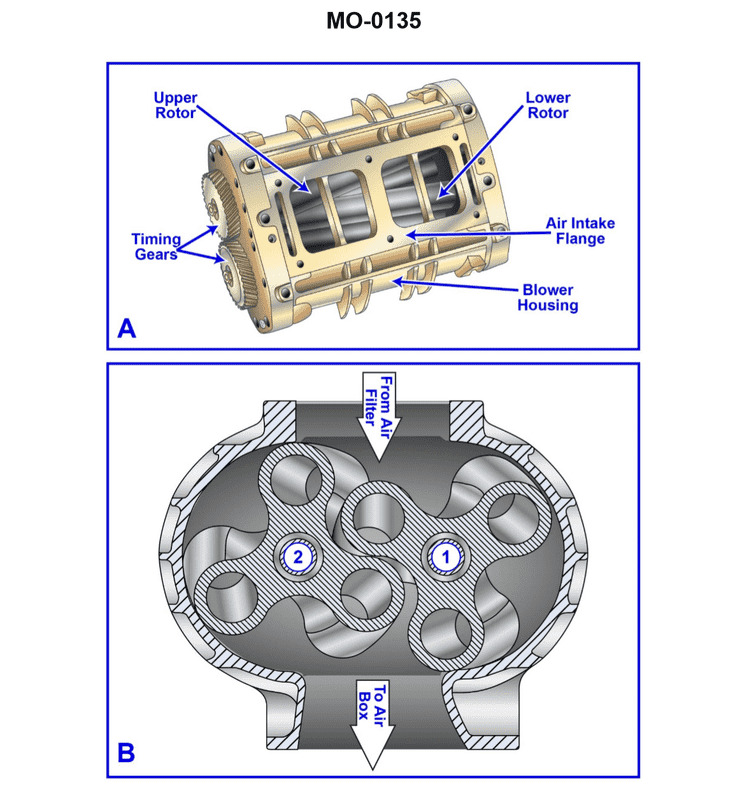
The Correct Answer is B **Explanation of why Option B is correct:** Roots-type blowers utilize two rotors (lobes) that spin very close to one another but must never touch. The primary function of the timing gears within the blower unit itself is to maintain this precise, non-contacting relationship between the two rotors, ensuring they remain properly phased and spaced apart with a close tolerance throughout their operation. Furthermore, the gears shown in figure "A" (which typically depicts the gears inside the blower housing) are usually *helically cut* in modern Roots blowers (especially those used on marine engines) because helical gears provide smoother, quieter operation and can handle higher loads and speeds compared to straight-cut gears. **Explanation of why other options are incorrect:** * **A) The timing gears are helically cut and ensure that the blower is properly timed to the engine's crankshaft.** This is incorrect. While the gears are often helical, the timing gears *inside* the blower (the gears shown in figure "A") do not time the blower to the engine's crankshaft. They only time the two blower rotors relative to each other. The relationship between the blower's drive shaft and the engine's crankshaft is handled by the main drive train (belts, gears, or coupling) connecting the blower to the engine. * **C) The timing gears are straight cut and ensure that the blower rotor lobes are properly spaced apart with a close tolerance.** This is incorrect. While the function described (spacing the lobes) is correct, the gears in modern, high-speed applications like marine engines are typically *helically cut* for smooth, quiet operation, not straight cut. * **D) The timing gears are straight cut and ensure that the blower is properly timed to the engine's crankshaft.** This is incorrect for two reasons: the gears are typically helical, and their function is to time the rotors relative to each other, not the blower unit relative to the engine's crankshaft.
Pass Your Coast Guard Licensing Exams!
Study offline, track your progress, and simulate real exams with the Coast Guard Exams app