Question 30 OSE01 - Chief Engineer - OSV
The offshore supply vessel to which you are assigned is fitted with a totally pneumatic propulsion control system as shown in the illustration. If propulsion control functions perfectly from the engine room control station, but will not function at all from any of the remote stations, which of the following system faults best accounts for these symptoms? Illustration MO-0168
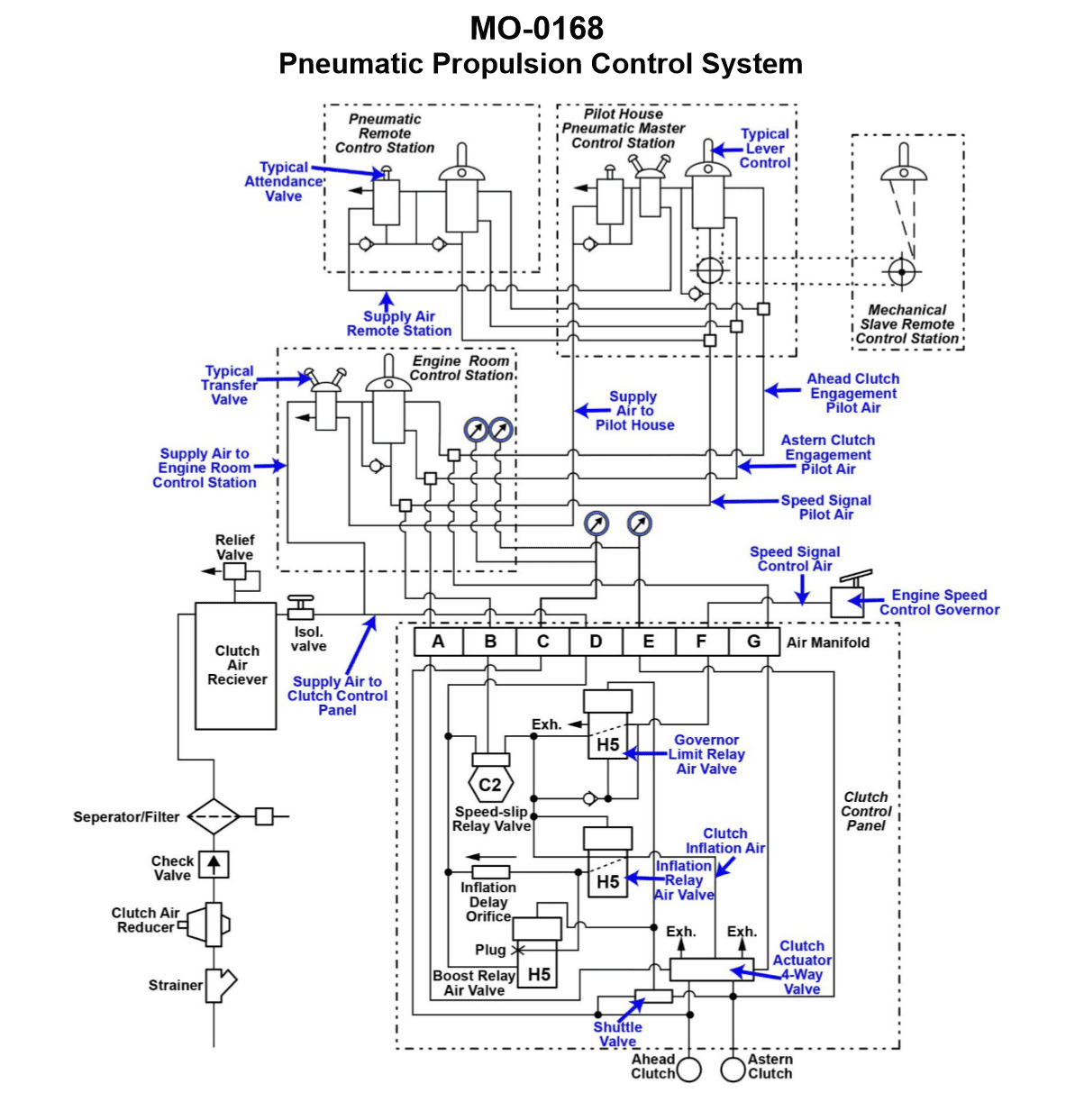
The Correct Answer is A. **Explanation for Option A (Correct Answer):** The symptoms described are that propulsion control functions perfectly from the **engine room control station (local control)**, but **will not function at all from any of the remote stations** (e.g., pilot house, bridge wing). The control authority for the engine is governed by a local/remote transfer valve located at the main engine control station (engine room). * If the engine works perfectly locally, it means the main engine pneumatic actuator and the control system plumbing downstream of the transfer valve are functioning correctly. * For remote stations to take control, the signal from the remote station (e.g., the pilot house telegraph setting) must pass through the **remote port** of the local/remote transfer valve and then on to the engine actuator. * If the remote port of this transfer valve is blocked, the remote signal cannot reach the engine control mechanism. The system remains effectively stuck in the local position (or the engine only responds to the local setting), preventing any remote commands from being executed. This perfectly matches the described scenario: Local control works, Remote control fails completely. **Explanation for Other Options (Incorrect):** **B) The attendance valve at the pneumatic remote-control station has a blocked outlet port.** The attendance valve (or 'Deadman' valve) must be activated at the remote station for that station to gain control. If the attendance valve at *one* remote station (e.g., the pilot house) had a blocked outlet, only that specific station would fail to function. However, the problem states that control fails from *all* remote stations. A single, critical blockage common to all remote commands (like the local/remote transfer valve in the engine room) is a better explanation than multiple, simultaneous faults at every remote station. **C) The local/remote transfer valve at the engine room control station has a blocked local port.** If the local port were blocked, the engine could not be controlled from the engine room control station. However, the problem states that control functions perfectly from the engine room (local) station. Therefore, this fault does not match the symptoms. **D) The pilot house/remote transfer valve at the pilot house has a blocked remote port.** A transfer valve in the pilot house typically transfers authority between the pilot house station and other secondary remote stations (like bridge wings). If the pilot house/remote transfer valve had a blocked remote port, it would only affect the ability of the secondary remote stations to control the engine *through* the pilot house console. It would not prevent the pilot house console itself (which is the main remote station) from functioning, nor would it explain the failure of all remote stations unless the fault was at the master control transfer point in the engine room, which is option A.
Pass Your Coast Guard Licensing Exams!
Study offline, track your progress, and simulate real exams with the Coast Guard Exams app