Question 32 ONC07 - OUPV-Near Coastal
BOTH INTERNATIONAL & INLAND Which of the following describes a vessel exhibiting the lights shown in illustration D084RR below?
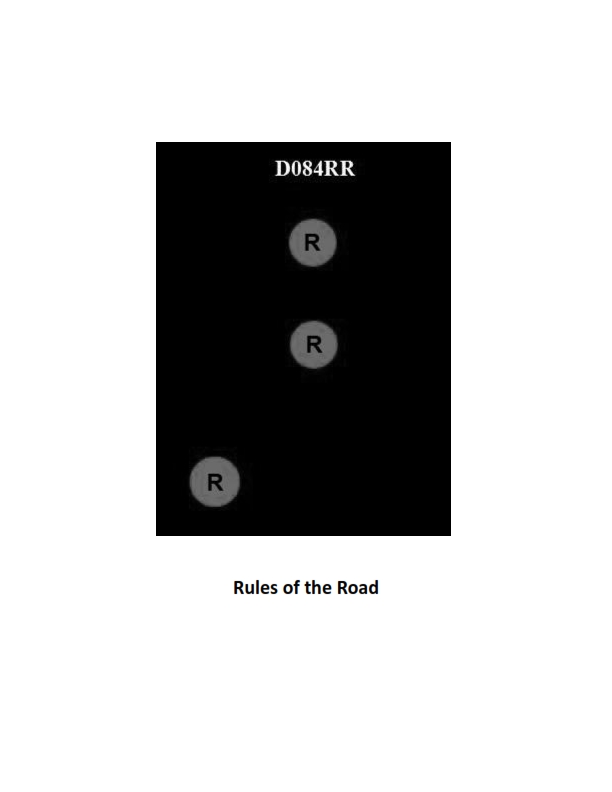
The Correct Answer is A. ### Explanation for Option A (Correct Answer) Option A, **not under command**, is correct because the illustration D084RR depicts a vessel exhibiting **two all-round red lights displayed vertically** where they can best be seen. According to both the International Regulations for Preventing Collisions at Sea (COLREGs), Rule 27(a), and Inland Rules, Rule 27(a), a vessel that is **not under command (NUC)**—meaning she is unable to maneuver as required by the Rules and is, therefore, unable to keep out of the way of another vessel—must exhibit two such all-round red lights. When underway, this vessel must also exhibit sidelights and a sternlight. ### Explanation of Incorrect Options **B) showing improper lights:** This is incorrect. The lights shown (two vertical all-round red lights) are the *prescribed* and *proper* lights for a vessel that is not under command, as defined by the Rules. **C) dredging:** This is incorrect. A vessel engaged in dredging or underwater operations (restricted in her ability to maneuver, or RAM) exhibits three vertical all-round lights: Red-White-Red. The illustration shows only two all-round red lights. **D) towing:** This is incorrect. A power-driven vessel engaged in towing exhibits two or three masthead lights (depending on the length of the tow) in a vertical line, along with sidelights and a sternlight, and a towing light (yellow sternlight substitute) above the sternlight. The illustration shows two all-round red lights, which are specifically the NUC signal, not the towing signal.
Pass Your Coast Guard Licensing Exams!
Study offline, track your progress, and simulate real exams with the Coast Guard Exams app