Question 28 ONC07 - OUPV-Near Coastal
INLAND ONLY Vessels "A" and "B" are meeting on a river as shown in illustration D041RR below and will pass 1/4 mile apart. Which is one of the lights on vessel "B" that you will see if you are on vessel "A"?
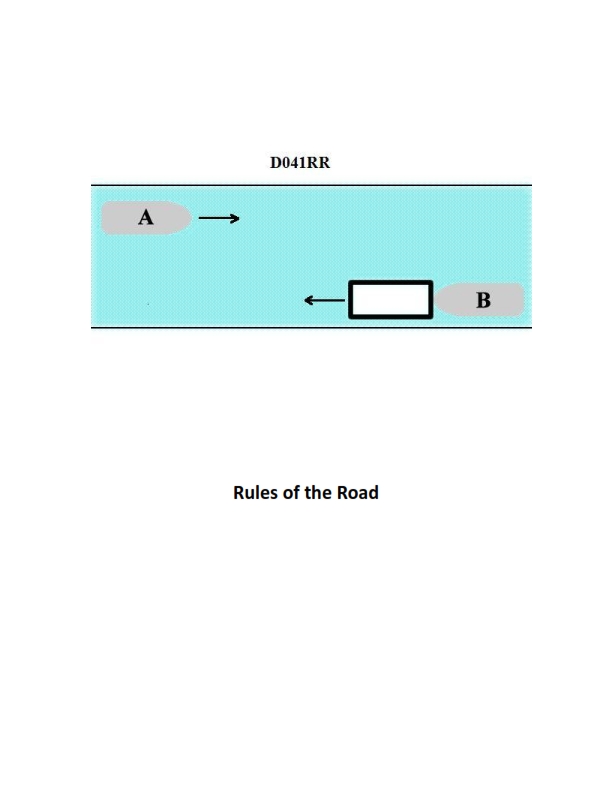
The Correct Answer is C ### Explanation for why C is correct: Vessel B is depicted as a vessel engaged in a towing operation where the length of the tow (measured from the stern of the towing vessel to the aftermost end of the tow) exceeds 200 meters, which requires specific masthead lights and side lights. However, the scenario specifically states that both vessels are operating "INLAND ONLY" and are meeting on a river, passing 1/4 mile apart. In Inland Rules (33 CFR Subchapter E), vessels pushing ahead or hip-towing are often treated differently than conventional towing operations. More importantly, **Rule 24(g) of the Inland Rules** dictates specific lighting requirements for vessels pushing ahead or hip-towing (flanking) on the Western Rivers (Mississippi River and its tributaries, etc.) or on waters specified by the Secretary (e.g., portions of the Gulf Intracoastal Waterway). When pushing ahead or hip-towing on these specific waters, the vessel must display, in addition to the standard lights for a power-driven vessel, **two yellow flashing lights** (commonly referred to as "special flashing lights" in navigation contexts, though Rule 24(g) refers to them as "a special flashing light") displayed in a vertical line above the forward masthead light, in place of the second masthead light. Since the vessel is clearly operating on an inland river and is engaged in a towing operation (likely pushing ahead, which is common on inland rivers), the most unique and required light for this specific context, which would be visible to vessel A, is the **special flashing light**. ### Explanation for why other options are incorrect: **A) yellow towing light:** The yellow towing light (also known as the stern light when towing) is displayed above the white stern light, but it is **only visible from the stern** (135 degrees), facing aft. Since Vessel A is meeting Vessel B (i.e., they are approaching each other head-on or nearly head-on), the towing light on Vessel B would not be visible to Vessel A. **B) red sidelight:** Vessel B is a power-driven vessel, so it must display sidelights (red for port, green for starboard). Since Vessel A and Vessel B are meeting and passing 1/4 mile apart, if they are passing port-to-port, Vessel A would see Vessel B's **green sidelight** (starboard). If they are passing starboard-to-starboard, Vessel A would see Vessel B's **red sidelight** (port). However, without knowing the specific arrangement shown in Illustration D041RR (which is not provided, but typically depicts a passing situation), the sidelight is uncertain. Crucially, the **special flashing light (C)** is a required and unique light for this specific Inland towing operation and is highly visible from the front, making it a stronger required answer than a sidelight, which depends on the passing side. In many head-to-head illustrations, the special flashing light is designed to be seen clearly by an approaching vessel. **D) All of the above:** Since the yellow towing light (A) is not visible from the bow, this option is incorrect.
Pass Your Coast Guard Licensing Exams!
Study offline, track your progress, and simulate real exams with the Coast Guard Exams app