Question 28 ONC03 - Master LT 500-1600 GRT
INLAND ONLY Vessels "A" and "B" are meeting on a river as shown in illustration D041RR below and will pass 1/4 mile apart. Which is one of the lights on vessel "B" that you will see if you are on vessel "A"?
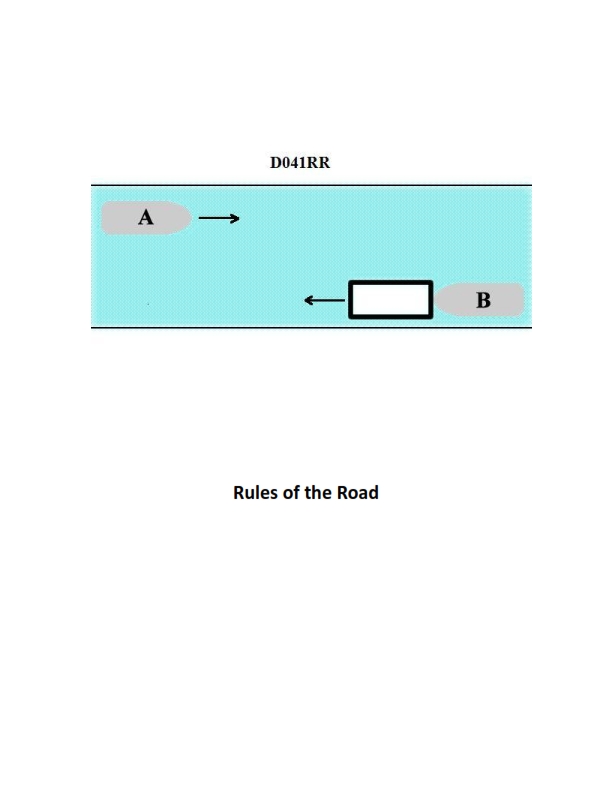
The Correct Answer is C ### Explanation for Option C (Correct) Vessel "B" is shown pushing ahead or towing alongside (as indicated by the configuration and the context of inland rules, particularly the requirement for specific lights when engaged in towing/pushing). However, the key identifier in this specific scenario (where both vessels are meeting and will pass 1/4 mile apart, and both are labeled "INLAND ONLY") is the presence of a **special flashing light** on the vessel pushing ahead. According to Inland Rule 23(a)(iv) (or equivalent national regulations for towing vessels on inland waterways), a pushing vessel that is part of a composite unit or is pushing ahead a tow, and whose tow extends more than 200 meters ahead, must exhibit a special flashing light. Even if the tow length is not specified, in common inland towing configurations where a barge is being pushed, the vessel pushing ahead (Vessel B in this configuration) typically displays this light to indicate the pushing operation to other vessels, especially when viewed from the tow's side or ahead. Furthermore, another context where the special flashing light is mandatory is for vessels engaged in **federally regulated dredging or surveying operations** (Inland Rule 27(d)) or for certain types of **high-speed craft** (Inland Annex IV), though the most likely reason Vessel B displays this light in a standard meeting scenario is its towing operation configuration. Since Vessel B is clearly a pusher tug/towboat, and "special flashing light" is offered as an option, it represents a distinctive and mandatory light for a vessel engaged in pushing ahead on inland waters. ### Explanation for Incorrect Options **A) yellow towing light:** The yellow towing light (required by Rule 21(d) in International Rules, and often referred to in Inland Rules as the second masthead light used specifically for towing) is displayed **above** the sternlight and is only visible from astern (3 points abaft the beam on either side). Since Vessel A is approaching Vessel B from ahead/slightly off the bow in a meeting situation, Vessel A will not see the stern-facing yellow towing light. **B) red sidelight:** The red sidelight indicates the port (left) side of the vessel. In a meeting situation where vessels are passing 1/4 mile apart, if Vessel A is approaching Vessel B nearly head-on (as implied by the standard meeting scenario), Vessel A would see Vessel B's **green sidelight** (starboard side) and masthead lights, but not the red sidelight, which is obscured by the vessel's structure when viewed from the starboard bow/ahead. **D) All of the above:** Since options A and B are incorrect, this option must also be incorrect.
Pass Your Coast Guard Licensing Exams!
Study offline, track your progress, and simulate real exams with the Coast Guard Exams app