Question 20 ONC01 - Master/Chief Mate Unlimited Tonnage
BOTH INTERNATIONAL & INLAND You are on Vessel "A" engaged in fishing in a narrow channel as shown in illustration D037RR below. Vessel "B" is a tanker proceeding in the channel. Vessel "B" sounds five short and rapid blasts. What action should you take?
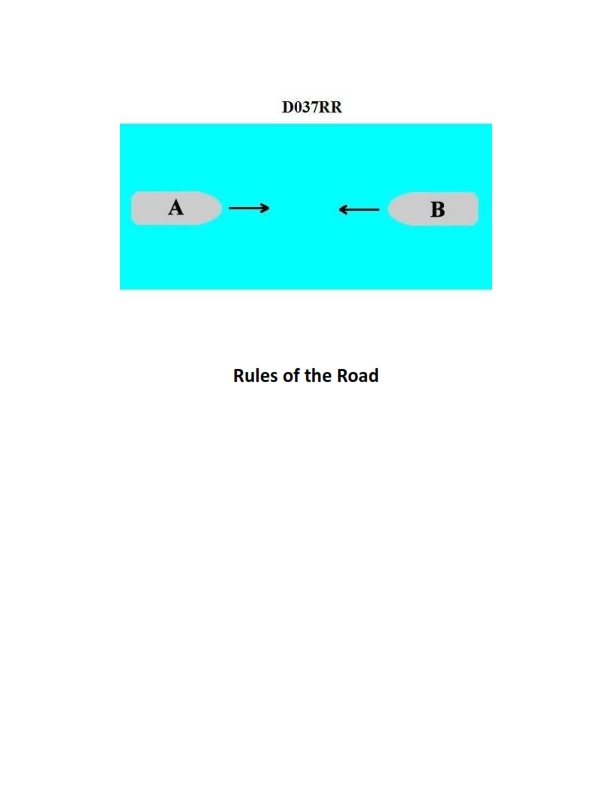
The Correct Answer is D ### **Explanation of Option D (not impede the passage of vessel "B")** Option D is correct because of the specific requirements governing navigation in narrow channels, coupled with the meaning of the five-blast signal. 1. **Rule 9 (Narrow Channels):** Rule 9(b) of the COLREGs states that a vessel engaged in fishing (Vessel A) shall **not impede the passage** of any other vessel (Vessel B, the tanker) which can safely navigate only within the narrow channel. Although fishing vessels generally have the right-of-way over power-driven vessels (Rule 18), the requirements of Rule 9 override that general priority when a vessel is operating in a narrow channel. 2. **The Signal:** Vessel B's signal of five short and rapid blasts is the danger or doubt signal (Rule 34(d)). By sounding this signal, Vessel B is clearly indicating that it doubts Vessel A’s intentions or actions, and believes that Vessel A is taking insufficient action to comply with Rule 9—meaning, Vessel B feels its safe passage is being impeded. 3. **Required Action:** Upon hearing the danger signal, Vessel A must immediately take appropriate action to ensure compliance with its obligation under Rule 9(b). This action is to maneuver clear and ensure that the passage of the large tanker is not impeded. ### **Explanation of Why Other Options Are Incorrect** **A) maintain course and speed:** This is incorrect. Maintaining course and speed would ignore the danger signal (five blasts) and perpetuate the situation that Vessel B perceives as dangerous or an impediment. Vessel A has a specific obligation under Rule 9(b) to *not impede* the tanker, meaning a change in course and/or speed is likely necessary. **B) not answer the whistle signals from vessel "B":** This is incorrect. While silence might be acceptable when a maneuvering signal (one or two blasts) is understood and presents no immediate danger, the five-blast signal is a serious warning of doubt or perceived danger. Vessel A is required to take action to resolve the danger, which includes maneuvering or clarifying intentions, not simply remaining silent. **C) sound one prolonged followed by two short blasts:** This is incorrect. The signal of one prolonged followed by two short blasts (Rule 35(c)) is the signal used by a vessel engaged in fishing *only* when in or near an area of restricted visibility (fog, heavy rain, etc.). This rule is irrelevant for signaling maneuvering intentions in clear visibility.
Pass Your Coast Guard Licensing Exams!
Study offline, track your progress, and simulate real exams with the Coast Guard Exams app