Question 9 MODE02 - Assistant MODU Engineer
The thrust bearing shown in the illustration has over eight years of ahead running time. Measurements show "i1" is 4 mm and "i2" is 1 mm. Which of the following conditions is indicated and what steps should be taken, if any? Illustration MO-0121
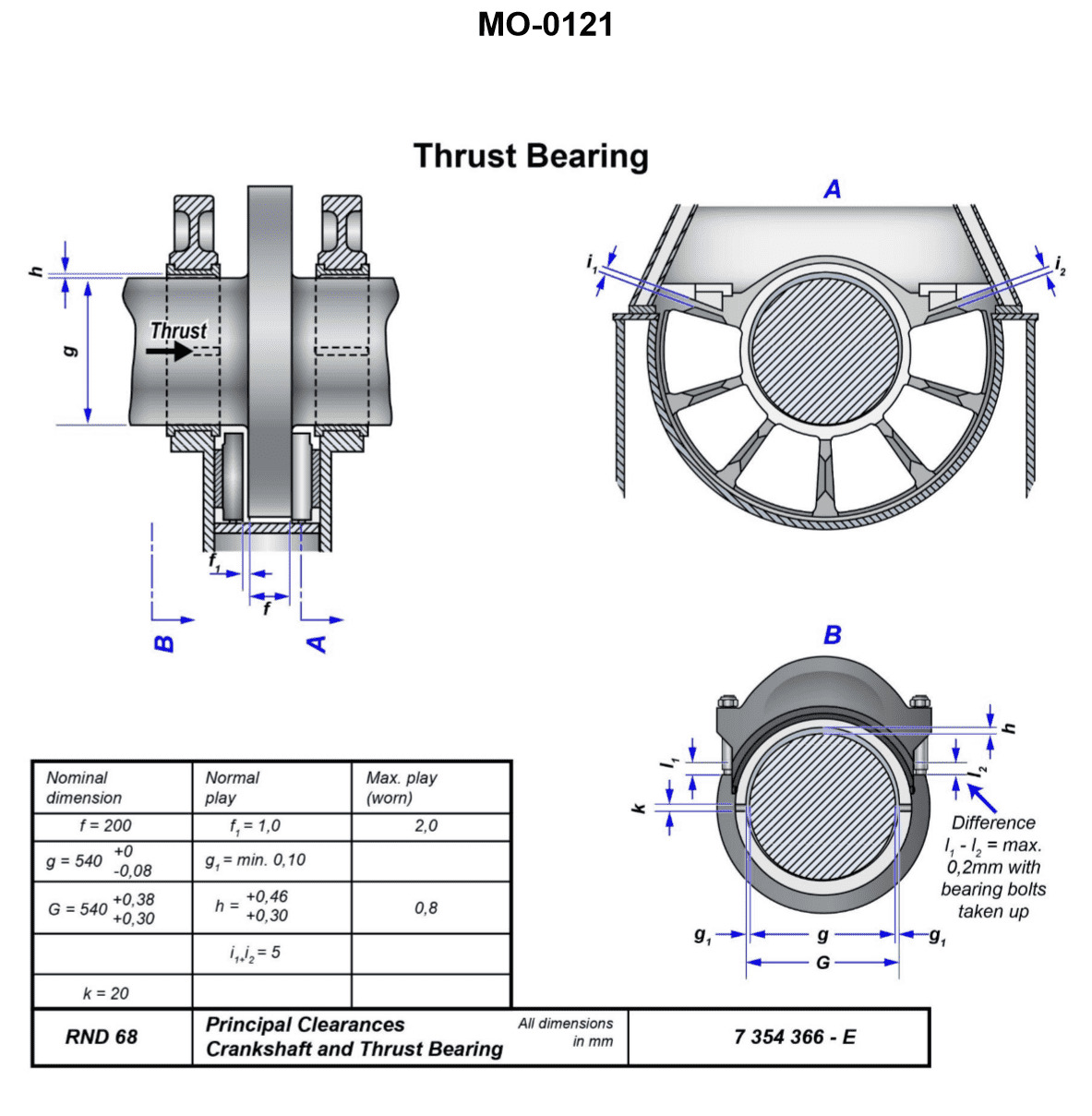
The Correct Answer is A ### 1. Why Option A is Correct Option A ("No appreciable wear has occurred, and the proper maintenance procedures should continue to be followed") is correct because, based on standard engineering practices for large marine or industrial thrust bearings: * **Assessment of $i1$ (Current Axial Float):** The measurement $i1 = 4 \text{ mm}$ typically represents the total measured axial float (end play) of the shaft. For many large propulsion or main machine thrust bearings, an axial float of $4 \text{ mm}$ falls well within the acceptable operating range (which can vary widely but often ranges up to $6 \text{ mm}$ or $7 \text{ mm}$ total float). * **Assessment of $i2$ (Astern Clearance):** The measurement $i2 = 1 \text{ mm}$ typically represents the residual clearance on the non-working (astern) side while the bearing is running ahead. A residual clearance of $1 \text{ mm}$ is sufficient for lubrication and indicates that the thrust collar is not hitting the astern pads prematurely. * **Conclusion:** Since both the total float ($4 \text{ mm}$) and the residual clearance ($1 \text{ mm}$) are within standard operational limits, the 8 years of service have resulted in minimal wear or no wear that exceeds maintenance thresholds. Therefore, the current maintenance regime is effective and should be continued. ### 2. Why Other Options Are Incorrect **B) A wear rate of 1.6 mm per year occurred. Although not excessive, this condition may require more frequent monitoring.** **D) A wear rate of 1.6 mm per year is excessive and requires immediate assistance from the manufacturer's field support.** * These options are based on an incorrect calculation of the wear rate. To achieve a wear rate of $1.6 \text{ mm}$ per year over 8 years, the total wear would have to be $12.8 \text{ mm}$. A thrust bearing experiencing $12.8 \text{ mm}$ of wear would have failed catastrophically long before the 8-year mark, and the measurements provided ($4 \text{ mm}$ and $1 \text{ mm}$) do not indicate such extreme wear. Since the measurements are within acceptable limits, the actual wear rate is negligible, making any calculation of $1.6 \text{ mm/year}$ irrelevant and incorrect. **C) The stops in which the thrust bearing block rides are worn, and it is necessary to return these to their original specifications.** * If the current axial float ($i1 = 4 \text{ mm}$) is within acceptable operational limits, there is no indication of excessive wear on the thrust pads or the stops/collars. This action would only be necessary if $i1$ significantly exceeded the maximum allowable float (e.g., $i1 = 10 \text{ mm}$), which is not the case here.
Pass Your Coast Guard Licensing Exams!
Study offline, track your progress, and simulate real exams with the Coast Guard Exams app