Question 3 GLI08 - Limited OUPV
INLAND ONLY You are on power-driven vessel "A" and power-driven vessel "B" desires to overtake you on the starboard side as shown in illustration D038RR below. After the vessels have exchanged one blast signals what action should you take?
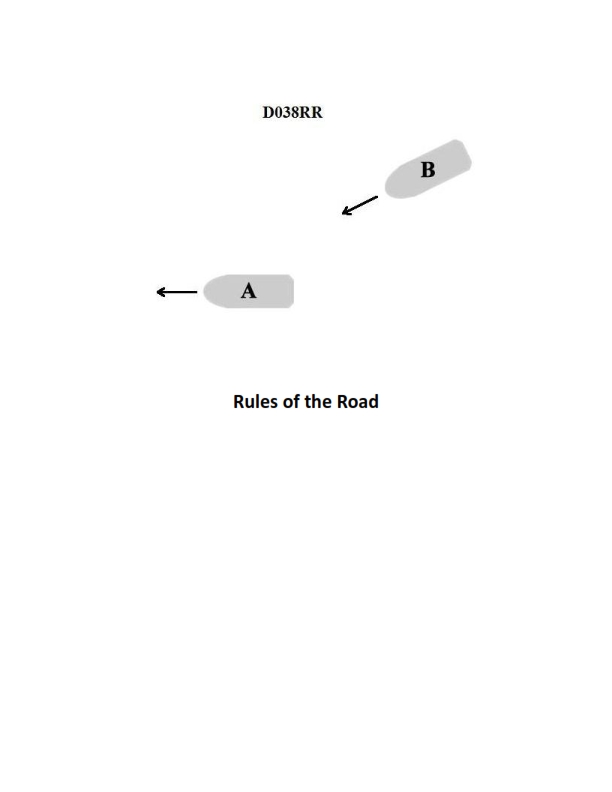
The Correct Answer is B **Explanation of Option B (Hold course and speed):** In an overtaking situation under the Inland Rules, the vessel being overtaken (Vessel A) is considered the stand-on vessel relative to the overtaking vessel (Vessel B) once agreement has been signaled. According to Inland Rule 17(a)(ii), the stand-on vessel (in this case, Vessel A) must **maintain her course and speed**. This predictability is crucial for the safety of the maneuver, allowing the overtaking vessel (Vessel B) to calculate the time and distance needed to safely pass. Since the vessels have already exchanged signals, confirming the maneuver, Vessel A's primary duty is to hold steady. *** **Explanation of Incorrect Options:** **A) Slow your vessel until vessel "B" has passed:** The vessel being overtaken must maintain speed. Slowing down (reducing speed) or stopping is generally prohibited because it creates confusion and alters the dynamics of the overtake, potentially putting Vessel B into a dangerous situation that they did not anticipate when signaling their maneuver. **C) Alter course to the left or right to give vessel "B" more sea room:** The rules specifically require the stand-on vessel (Vessel A) to maintain course. Altering course, whether to the left or right, introduces the risk of collision by moving Vessel A unpredictably or steering it directly into the path of the overtaking vessel (Vessel B). **D) Alter course to the left:** This is a specific violation of the rule requiring the maintenance of course. Additionally, if Vessel B is overtaking on the starboard side (right side), Vessel A altering course to the left (port) could swing its stern toward Vessel B or restrict the navigable space, greatly increasing the risk of contact.
Pass Your Coast Guard Licensing Exams!
Study offline, track your progress, and simulate real exams with the Coast Guard Exams app