Question 20 GLI06 - Master or Mate of LT 100 GRT
BOTH INTERNATIONAL & INLAND You are on Vessel "A" engaged in fishing in a narrow channel as shown in illustration D037RR below. Vessel "B" is a tanker proceeding in the channel. Vessel "B" sounds five short and rapid blasts. What action should you take?
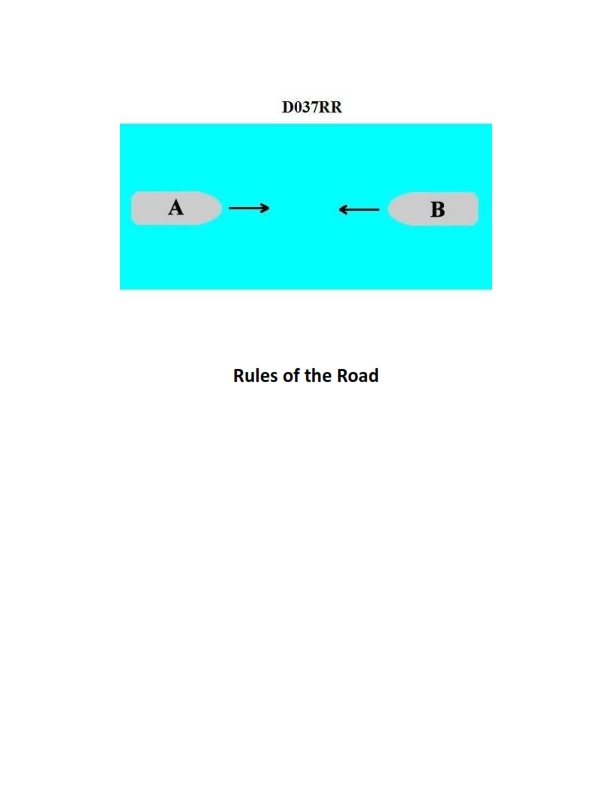
The Correct Answer is D **Explanation for D (not impede the passage of vessel "B"):** This scenario involves both the International Regulations for Preventing Collisions at Sea (COLREGs) and Inland Rules. 1. **Vessel Status:** Vessel "A" is engaged in fishing, making it a "vessel restricted in its ability to maneuver" (Rule 3(g) defines fishing as such for maneuvering purposes). Vessel "B" is a tanker proceeding in a narrow channel. 2. **Narrow Channel Rule (Rule 9):** Rule 9 requires vessels to keep to the starboard side of the channel and also specifically states (Rule 9(b) [Inland] or 9(c) [International]) that a vessel engaged in fishing shall not impede the passage of any other vessel navigating within a narrow channel or fairway. 3. **Whistle Signal:** Vessel "B" sounds five short and rapid blasts. This is the danger/doubt signal (Rule 34(d)). In this context, Vessel "B" is signaling its apprehension that Vessel "A" is about to violate Rule 9 by impeding its passage or is failing to take required action. 4. **Action Required:** Since Rule 9 obligates the fishing vessel ("A") not to impede the passage of the large vessel ("B") constrained by the narrow channel, Vessel "A" must take all necessary action (which usually means moving clear or slowing down) to ensure it does **not impede** the tanker's passage. **Why the other options are incorrect:** * **A) maintain course and speed:** This is incorrect because Vessel "A" is a burdened vessel (required not to impede) under Rule 9. Maintaining course and speed directly contributes to impeding the tanker, which is exactly what Vessel "B" is signaling danger about. * **B) not answer the whistle signals from vessel "B":** While the five-blast signal is a warning and not typically answered with a specific maneuvering signal, the vessel hearing it is obligated to take action to remove the danger. Ignoring the signal and taking no action is dangerous and violates the requirement not to impede the passage. * **C) sound one prolonged followed by two short blasts:** This signal is the mandatory signal for a sailing vessel when passing in a narrow channel (International Rule 9(e)(ii) only) or the signal used by a vessel requesting to be passed on the starboard side (Inland Rule 34(a)(ii)). Vessel "A" is a fishing vessel, not a sailing vessel, and its priority here is to *clear* the channel, not initiate a complex passing maneuver or claim right-of-way. Using this signal would be inappropriate and confusing given the immediate danger signal sounded by the tanker.
Pass Your Coast Guard Licensing Exams!
Study offline, track your progress, and simulate real exams with the Coast Guard Exams app