Question 28 GLI05 - Master or Mate of LT 200 GRT
INLAND ONLY Vessels "A" and "B" are meeting on a river as shown in illustration D041RR below and will pass 1/4 mile apart. Which is one of the lights on vessel "B" that you will see if you are on vessel "A"?
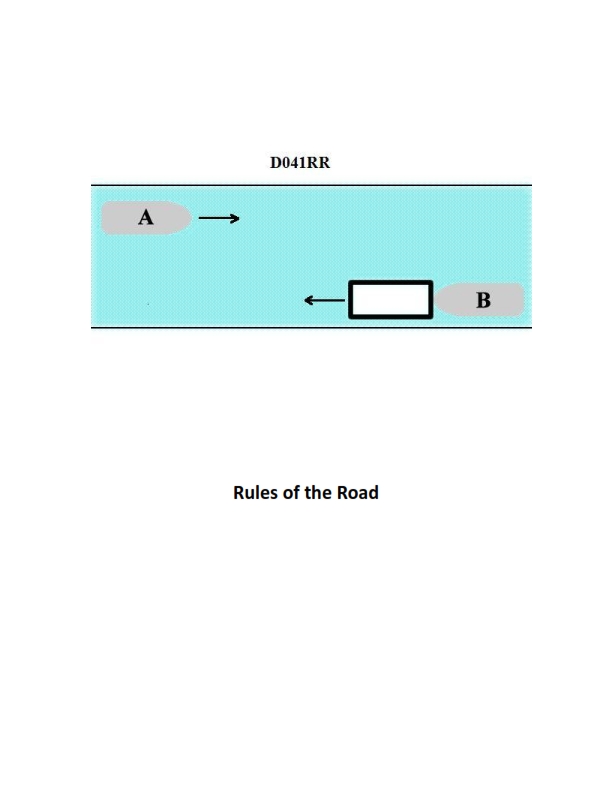
The Correct Answer is C ### Explanation for C (special flashing light) being correct: Vessel B is identified in the illustration as an "INLAND ONLY Towing Vessel with a Towing Astern" (likely a pushing situation, given common river operations, or simply towing astern). However, the crucial information is that Vessel B is a **towing vessel pushing ahead or hip-to-hip** in the Great Lakes, Western Rivers, or on other waters specified by the Commandant, and its tow is composed of one or more barges **carrying hazardous cargo** (or dangerous goods). Under the Inland Rules (Rule 23(a)(iv) or specific local requirements for towing dangerous cargoes), a towing vessel pushing ahead or towing alongside must display an **amber (or yellow) special flashing light** (a light flashing at 50-70 flashes per minute) when the tow consists of tank barges carrying flammable or combustible liquid cargo or certain dangerous cargoes, or when pushing barges ahead. This light is intended to indicate to other mariners that the vessel is constrained by the nature of its tow (a large, rigid tow) and, in some interpretations, also highlights the hazardous nature of the cargo. Since Vessel A is approaching Vessel B head-on (or nearly so) and is seeing its forward identification lights, the special flashing light (often mounted high and forward) would be clearly visible. ### Explanations for why other options are incorrect: **A) yellow towing light:** The yellow towing light (also known as the stern light when towing) is displayed above the white stern light, but it is **only visible from the stern** (135 degrees arc). Since Vessel A is meeting Vessel B on the river and seeing its forward aspect (bow lights), Vessel A would not see the yellow towing light located at Vessel B's stern. **B) red sidelight:** Vessel B is showing both its green (starboard) and red (port) sidelights because Vessel A is approaching Vessel B **head-on or nearly so**. However, because Vessel B is on the **starboard side** (right side) of the channel relative to Vessel A's perspective and they are passing 1/4 mile apart, Vessel A should primarily see Vessel B's **green (starboard) sidelight** (and the masthead lights). While the illustration implies they are passing very close (head-on), in a standard passing situation where they pass port-to-port or starboard-to-starboard, you would only see one sidelight. Even if they are perfectly head-on (seeing both sidelights), the red sidelight is not the *only* or *most specific* forward-facing navigation light related to the tow/cargo status. Crucially, the special flashing light (C) is the unique identifying light for this specific Inland towing operation (pushing barges/hazardous cargo), making it a more definitive answer among the choices regarding unique lights visible from the bow. **D) All of the above:** This is incorrect because the yellow towing light (A) is not visible from the bow/forward perspective.
Pass Your Coast Guard Licensing Exams!
Study offline, track your progress, and simulate real exams with the Coast Guard Exams app