Question 32 GLI04 - Mate of LT 500-1600 GRT
BOTH INTERNATIONAL & INLAND Which of the following describes a vessel exhibiting the lights shown in illustration D084RR below?
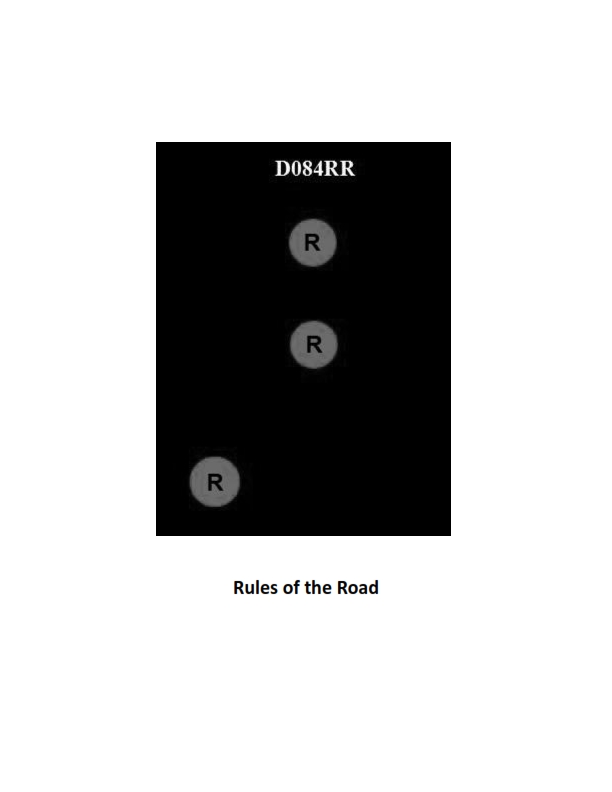
The Correct Answer is A ### Explanation of Correct Option (A) **A) not under command** A vessel that is **Not Under Command (NUC)**—meaning it is unable to maneuver as required by the Rules due to some exceptional circumstance—must display specific lights according to the International and Inland Rules (COLREG Rule 27(a)). The defining characteristic of a vessel not under command is the display of **two all-round red lights in a vertical line**. This configuration is immediately recognizable as the NUC signal, indicating the vessel is severely restricted in its ability to navigate or avoid other traffic. ### Explanation of Incorrect Options **B) showing improper lights** This configuration (two vertical all-round red lights) is a defined, proper signal under Rule 27(a). If displayed correctly, it is a legitimate signal indicating the vessel's restricted status, not an improper one. **C) dredging** A vessel engaged in **dredging or underwater operations** must show three all-round lights in a vertical line: Red-White-Red (R-W-R). Additionally, it must show two vertical red lights to indicate the obstructed side and two vertical green lights to indicate the side on which another vessel may safely pass (Rule 27(d)). The lights for NUC (two vertical red lights only) do not match the required configuration for dredging. **D) towing** A vessel engaged in **towing** displays two or three masthead lights (white lights) in a vertical line (depending on the length of the tow), in addition to standard running lights. Since NUC uses all-round red lights, it cannot be mistaken for a towing vessel.
Pass Your Coast Guard Licensing Exams!
Study offline, track your progress, and simulate real exams with the Coast Guard Exams app