Question 20 GLI04 - Mate of LT 500-1600 GRT
BOTH INTERNATIONAL & INLAND You are on Vessel "A" engaged in fishing in a narrow channel as shown in illustration D037RR below. Vessel "B" is a tanker proceeding in the channel. Vessel "B" sounds five short and rapid blasts. What action should you take?
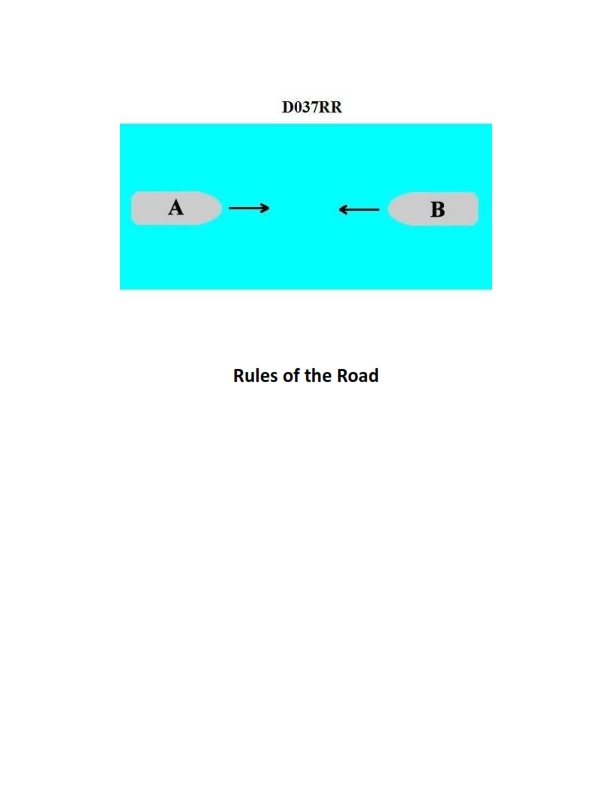
The Correct Answer is D. **Explanation for Option D (Correct Answer):** Option D, "not impede the passage of vessel 'B'," is the correct action because it directly addresses the situation governed by Rule 9 (Narrow Channels) of both the International Regulations for Preventing Collisions at Sea (COLREGs) and the Inland Rules. 1. **Context:** Vessel "A" is engaged in fishing, making it a "vessel engaged in fishing" and therefore a Vessel Constrained by her Draught (VCD), and has a right to be in the channel. Vessel "B" is a tanker, which is likely a large power-driven vessel, and depending on its draft, might be a VCD. 2. **Signal Meaning:** Vessel "B" sounds five short and rapid blasts. This is the **danger/doubt signal** (Rule 34(d)). In a narrow channel context, especially when directed at a vessel that might impede passage, this signal typically indicates that Vessel "B" believes Vessel "A" is acting unsafely, or that Vessel "A"'s current action/presence will impede Vessel "B"'s ability to proceed safely in the channel. 3. **Narrow Channel Rule (Rule 9):** Rule 9(b) explicitly states: "A vessel of less than 20 meters in length or a sailing vessel shall not impede the passage of a vessel which can safely navigate only within a narrow channel or fairway." Rule 9(c) (Inland only, but the spirit applies internationally) and Rule 9(d) (International and Inland) further emphasize that vessels engaged in fishing shall not impede the passage of any other vessel navigating within the narrow channel. 4. **Conclusion:** Regardless of the immediate danger signal, Vessel "A" (fishing vessel) has the statutory obligation under Rule 9 to ensure it does not impede the passage of Vessel "B" (a large tanker proceeding in the channel). The danger signal reinforces the urgency of complying with this duty. *** **Explanation of Incorrect Options:** * **A) maintain course and speed:** This is incorrect and highly dangerous. Maintaining course and speed directly ignores the statutory obligation not to impede (Rule 9) and disregards the explicit danger signal (five short blasts), which indicates that Vessel "B" believes a collision or unsafe situation is developing if Vessel "A" continues its current action. * **B) not answer the whistle signals from vessel "B":** This is incorrect. While the five-blast signal is a danger signal, not an invitation for a maneuvering signal (like answering one prolonged followed by two shorts), ignoring it is poor seamanship. The five-blast signal demands immediate corrective action (Rule 34(d)) to remove the danger. The necessary action is dictated by Rule 9, which is to not impede, not simply to remain silent. * **C) sound one prolonged followed by two short blasts:** This is incorrect. The signal "one prolonged followed by two short blasts" is the maneuvering signal used by a vessel engaged in fishing in a narrow channel **only** under Inland Rules (Rule 9(e)(i)) to indicate an intention to cross or enter the channel from the starboard side (and is used to indicate a vessel is engaged in fishing, though often misinterpreted). It is **not** the appropriate response to a general danger signal (five blasts) from a vessel requiring non-impeded passage; the required action is to yield/not impede, not to initiate a specific crossing maneuver.
Pass Your Coast Guard Licensing Exams!
Study offline, track your progress, and simulate real exams with the Coast Guard Exams app