Question 3 DDE04 - Designated Duty Engineer - 1000-4000 HP
You are assigned to a tractor tug fitted with main propulsion diesel engines of the type shown in the illustration. How many degrees of crankshaft revolution are required for all of the engine's cylinders to fire? Illustration MO-0227
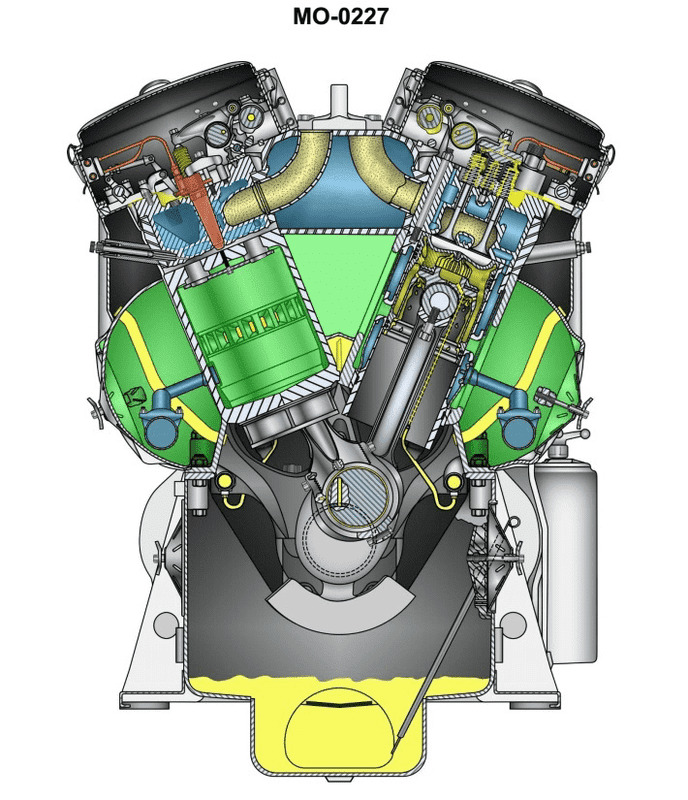
The Correct Answer is B **Explanation for Option B (360 degrees):** The question asks about the crankshaft revolutions required for *all* cylinders of the engine to fire, based on the provided context (a tractor tug fitted with main propulsion diesel engines) and the typical behavior of the engine type shown in Illustration MO-0227 (which standardly depicts a **two-stroke cycle diesel engine**). A two-stroke cycle engine completes a full power cycle (Intake, Compression, Power, Exhaust) in **one complete revolution of the crankshaft (360 degrees)**. This means that for every cylinder, the power stroke (firing) occurs once per 360 degrees of crankshaft rotation. Therefore, regardless of the number of cylinders (e.g., 6, 8, 12 cylinders), the engine is designed so that *across the entire engine* (i.e., all cylinders firing in sequence), the firing sequence repeats itself every 360 degrees of rotation. The firing interval between cylinders is calculated by dividing 360 degrees by the number of cylinders. The entire firing sequence (all cylinders firing once) is completed and repeats every 360 degrees. **Why the other options are incorrect:** * **A) 180 degrees:** While 180 degrees is the crankshaft rotation required for the power stroke in a *single cylinder* of a four-stroke engine, or the firing interval between some cylinders (like a V-twin engine), it is insufficient time for the full firing cycle of all cylinders in a multi-cylinder engine to complete and repeat. * **C) 720 degrees:** 720 degrees (two full crankshaft revolutions) is the total rotation required for a **four-stroke cycle engine** to complete its full cycle in a *single cylinder*. Since marine propulsion diesel engines, particularly in applications like tractor tugs, are very commonly high-power, high-torque, and often large **two-stroke cycle engines** (like those illustrated in typical marine engine diagrams corresponding to MO-0227), 720 degrees is incorrect for the entire firing sequence. * **D) Not enough information is given to determine crankshaft degrees of revolution:** Although the specific number of cylinders (e.g., 6, 8, 12) is not given, the underlying engine cycle (two-stroke cycle, typical of large marine diesels) determines the fundamental repeatability of the firing sequence. Since the entire firing sequence repeats every 360 degrees in a two-stroke engine, the fundamental answer is available based on the engine *type*.
Pass Your Coast Guard Licensing Exams!
Study offline, track your progress, and simulate real exams with the Coast Guard Exams app