Question 11 DDE04 - Designated Duty Engineer - 1000-4000 HP
The river push boat to which you are assigned is fitted with generator engines as partly shown in the illustration. What statement is true concerning the cylinders? Illustration MO-0163
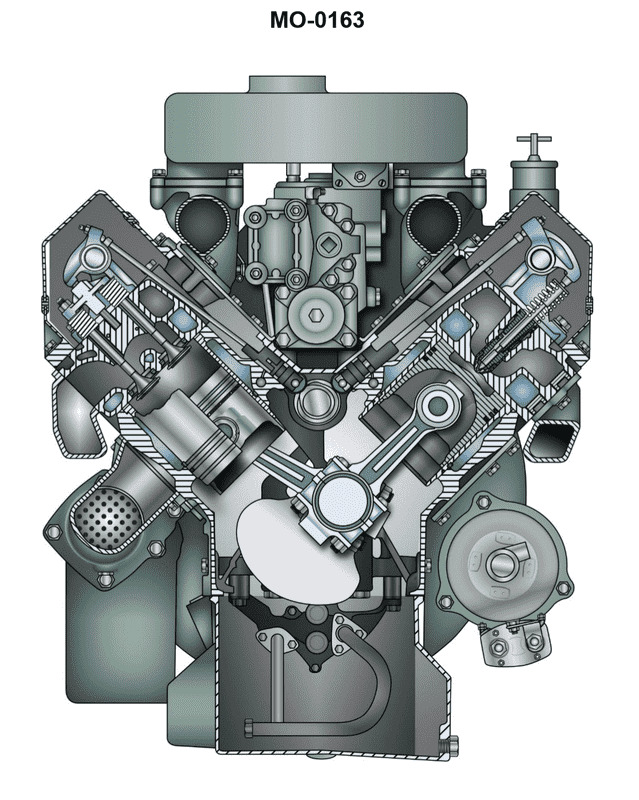
The Correct Answer is A ### Why Option A is Correct Option A states that **"The cylinder liners are of the wet type and are replaceable inserts."** This is the characteristic design choice for medium-to-large high-output diesel engines, such as those typically found powering river push boats (towboats). 1. **Wet Type Liners:** A wet liner is directly exposed to the engine coolant on its outer surface. This design offers superior heat dissipation because the cooling medium is in direct contact with the liner wall, which is essential for managing the high thermal loads of continuous duty marine diesel engines. 2. **Replaceable Inserts:** Cylinder liners are wear components. Designing them as replaceable inserts allows for significant maintenance savings. Instead of replacing the entire engine block when the cylinder bore wears down (or is damaged), technicians simply remove and replace the relatively inexpensive liner, restoring the engine to original specifications efficiently and cost-effectively. ### Why Other Options Are Incorrect **B) The cylinder liners are of the dry type and are replaceable inserts.** * **Incorrect:** Dry liners are fitted into a bored hole in the block and are not in direct contact with the coolant; the coolant contacts the block material surrounding the liner. While dry liners are used in some smaller engines, they do not offer the necessary cooling capacity for the sustained, high-power operation characteristic of large marine propulsion engines like those in a push boat. **C) The cylinder liners are of the jacketed type and are replaceable inserts.** * **Incorrect:** While the entire engine block is "jacketed" (surrounded by coolant passages), "jacketed type" is not the standard descriptive terminology used to differentiate liner types. The distinction is fundamentally between "wet" (direct coolant contact) and "dry" (indirect coolant contact). Therefore, this option uses non-standard or confusing terminology. **D) The cylinder walls are integral (non-replaceable) to the cylinder block.** * **Incorrect:** Integral cylinder walls (sometimes called parent bores) mean that the cylinder bore is machined directly into the cast iron of the engine block, with no separate liner. This design is almost exclusively limited to small automotive or low-duty industrial engines. It is fundamentally impractical for large, high-power marine diesel engines because it would necessitate scrapping or major remachining of the expensive engine block every time the cylinder bores wore out or were damaged. High-output marine diesels require the longevity and maintainability provided by replaceable liners.
Pass Your Coast Guard Licensing Exams!
Study offline, track your progress, and simulate real exams with the Coast Guard Exams app