Question 55 DDE01 - Designated Duty Engineer - Unlimited HP
The ship-docking tug to which you are assigned is fitted with main propulsion diesel engines of the type shown in the illustration. In terms of valve operating gear, cylinder liner type, and connecting rod type, what statement is true? Illustration MO-0192
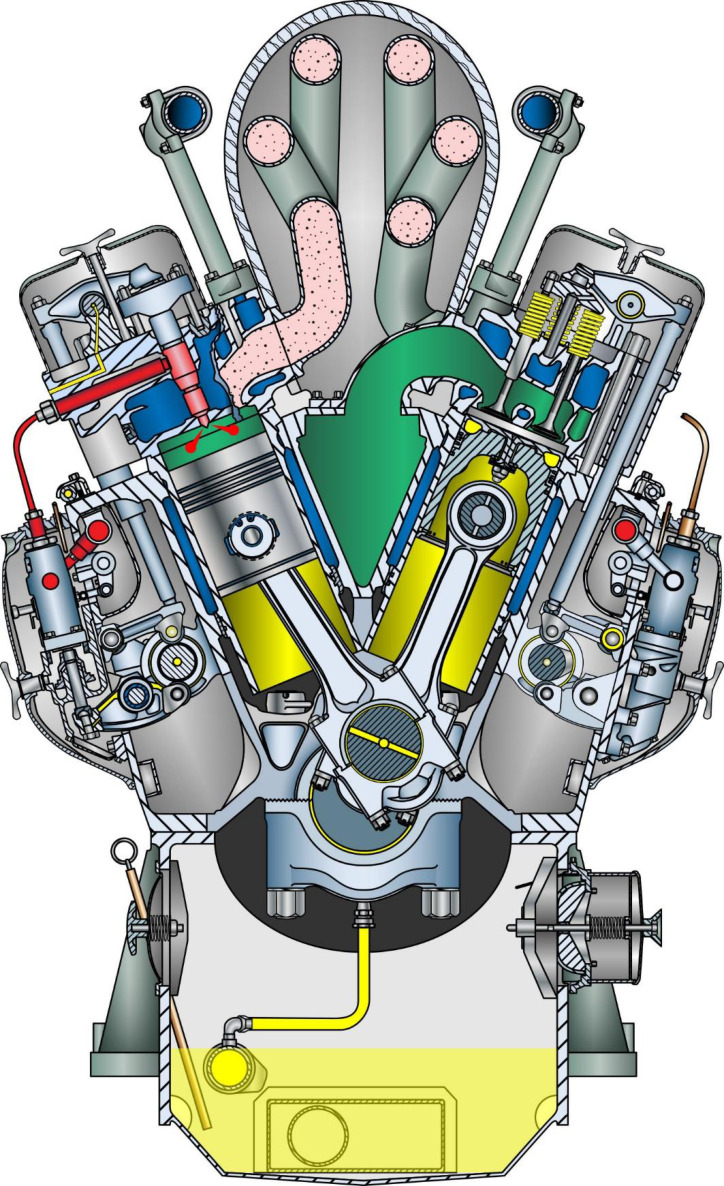
The Correct Answer is C ### Explanation of Why Option C is Correct The type of main propulsion diesel engine commonly used in ship-docking tugs, especially those depicted in standard marine engineering illustrations (like the inferred MO-0192, often representing medium-speed or high-speed four-stroke engines such as those by Cat, Cummins, or similar designs), typically features the following characteristics, corresponding to Option C: 1. **Pushrod operated overhead valve engine:** Medium-speed four-stroke engines often use a camshaft located in the cylinder block or crankcase, necessitating **pushrods** and **rocker arms** to actuate the valves in the cylinder head. This configuration is standard for robust, serviceable industrial marine diesels. 2. **Wet cylinder liners:** In these engines, the cylinder liners are directly exposed to the cooling water (jacket water) on their outer surface. This design, known as a **wet liner**, allows for superior cooling and easy replacement, making it standard for high-output marine engines. 3. **Conventional connecting rods:** These engines utilize standard, single-piece connecting rods connecting the piston to the crankshaft journal (also known as a simple or standard connecting rod). Specialized designs like marine-type (often used in very large two-stroke crosshead engines) or articulated (often used in V-engines where two cylinders share one crankpin) are typically not the default for this type of inline or standard V-engine used in tugs unless otherwise specified. ### Explanation of Why the Other Options Are Incorrect **A) This is an overhead cam engine, with jacketed cylinder liners and marine-type connecting rods.** * **Incorrect (Overhead cam):** While some modern high-speed diesels use overhead cams (OHC), the pushrod configuration (C) is more common for the medium-speed, high-durability engines typically found in tug propulsion systems illustrated in basic diagrams. * **Incorrect (Jacketed cylinder liners):** "Jacketed liners" is usually synonymous with "wet liners." However, "marine-type connecting rods" refers specifically to large connecting rods featuring a separate crosshead and slipper bearing (used in slow-speed two-stroke engines), which is incorrect for a tug's propulsion diesel. **B) This is a pushrod operated overhead valve engine, with jacketed cylinder liners and articulated connecting rods.** * **Incorrect (Articulated connecting rods):** Articulated connecting rods (where a main rod and a secondary rod share a crankpin) are used primarily in V-engines to achieve a compact design. While some tug engines might be V-type, the description assumes the most common/conventional configuration. If the engine is an inline engine, articulated rods are not used. Even in V-engines, conventional connecting rods (where the rods are side-by-side on the crankpin) are also widely used. The term "conventional" (in C) is a more universally applicable descriptor. **D) This is an overhead cam engine, with wet cylinder liners and conventional connecting rods.** * **Incorrect (Overhead cam):** As noted for Option A, the pushrod configuration (C) is often the standard configuration implied by basic textbook illustrations of medium-speed marine diesels, making the pushrod description (C) a safer and more frequently correct generalization than OHC (D).
Pass Your Coast Guard Licensing Exams!
Study offline, track your progress, and simulate real exams with the Coast Guard Exams app