Question 40 DDE01 - Designated Duty Engineer - Unlimited HP
The engine manufacturer for the main engines used on your harbor tug specifies a supplemental coolant additive consisting of molybdate and nitrite be used to supplement the heavy-duty antifreeze for the closed, re-circulating freshwater cooling system. A test-strip comparison chart as shown in the illustration is used for coolant testing purposes. If the molybdate concentration color corresponds to row 2 and the nitrite concentration color corresponds to column B, what statement is true? Illustration MO-0211
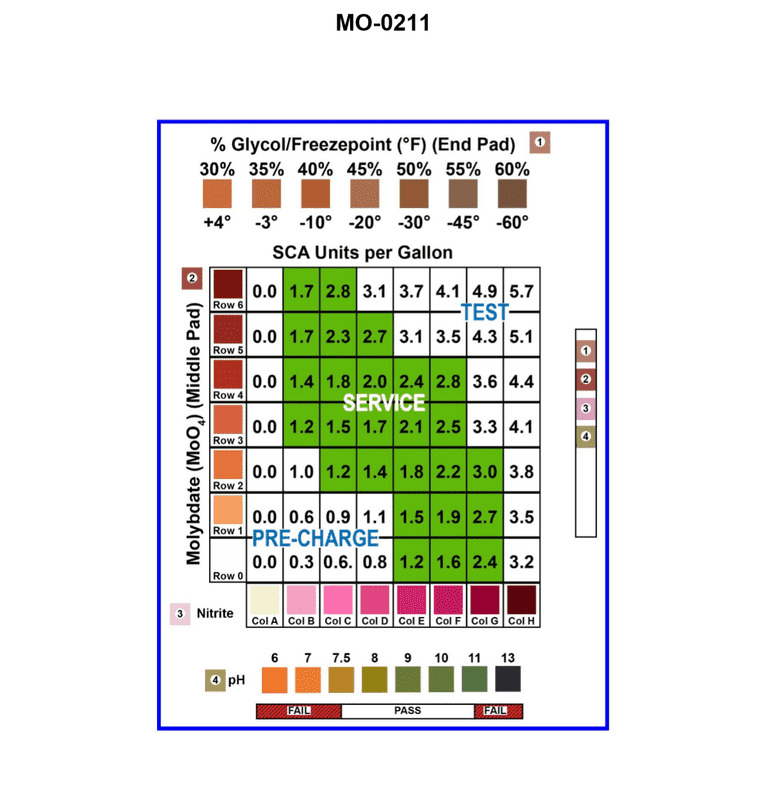
The Correct Answer is A **Explanation of why Option A is correct:** The scenario requires interpreting a hypothetical test-strip comparison chart (Illustration MO-0211, which we must visualize based on standard industry practice for SCA charts). These charts typically use a matrix where one axis represents the acceptable range for concentration levels (often indicated by color bands or rows/columns) and the intersection point provides a status (OK, Low, High). 1. **Molybdate Concentration:** The problem states the molybdate concentration color corresponds to **Row 2**. Based on standard SCA comparison charts, the ideal or target range is often centered (e.g., Row 3 or 4). If Row 2 is observed, it usually indicates a concentration level that is below the acceptable range. 2. **Nitrite Concentration:** The problem states the nitrite concentration color corresponds to **Column B**. Similarly, if the target range is typically centered (e.g., Column C or D), Column B usually indicates a concentration level that is below the acceptable range. 3. **Conclusion:** When the observed test strip results (Row 2 for molybdate and Column B for nitrite) fall outside the desired central or target zone (often designated as "OK" or "Acceptable") and are instead in the designated "Low" areas, both concentrations are insufficient. Therefore, additional Supplemental Coolant Additive (SCA), which contains both molybdate and nitrite, must be added to raise the levels back into the acceptable range. **Explanation of why the other options are incorrect:** * **B) The molybdate and nitrite concentrations levels are too high, and a portion of the coolant must be drained and replaced with fresh water.** This is incorrect because the observed levels (Row 2 and Column B) typically correspond to low or deficient concentrations, not excessive concentrations. Excessive concentrations (High) would typically require draining and replacement, but that is not the maintenance action indicated by the given readings. * **C) The molybdate and nitrite concentrations levels are within acceptable limits, and no further correction is required.** This is incorrect. If the results were within acceptable limits, the colors would correspond to the central row and column designated as "OK" or "Acceptable" (e.g., Row 3 or 4 and Column C or D, depending on the chart structure), not the lower-range indicators of Row 2 and Column B. * **D) It is not possible to determine the molybdate and nitrite concentration levels from the information given.** This is incorrect. While the specific chart (Illustration MO-0211) is not physically present, standard engine maintenance knowledge allows us to interpret that Row 2 and Column B, when used in a matrix comparing measured values to target values, represent values lower than the central, acceptable range (e.g., the target might be Row 3/4 and Column C/D). Therefore, a determination of "low concentration" is possible and necessary for this type of test question.
Pass Your Coast Guard Licensing Exams!
Study offline, track your progress, and simulate real exams with the Coast Guard Exams app