Question 28 DDE01 - Designated Duty Engineer - Unlimited HP
The freshwater cooling systems serving the main engines on your harbor tug are arranged as shown in the illustration. If the fresh water thermostatic control valve fails in the position where 100% of the flow from flange "A" is permanently ported to flange "B" and flange "C" is permanently blocked, while starting and warming the engine with no load, what would be the resulting warm up time period? Illustration MO-0137
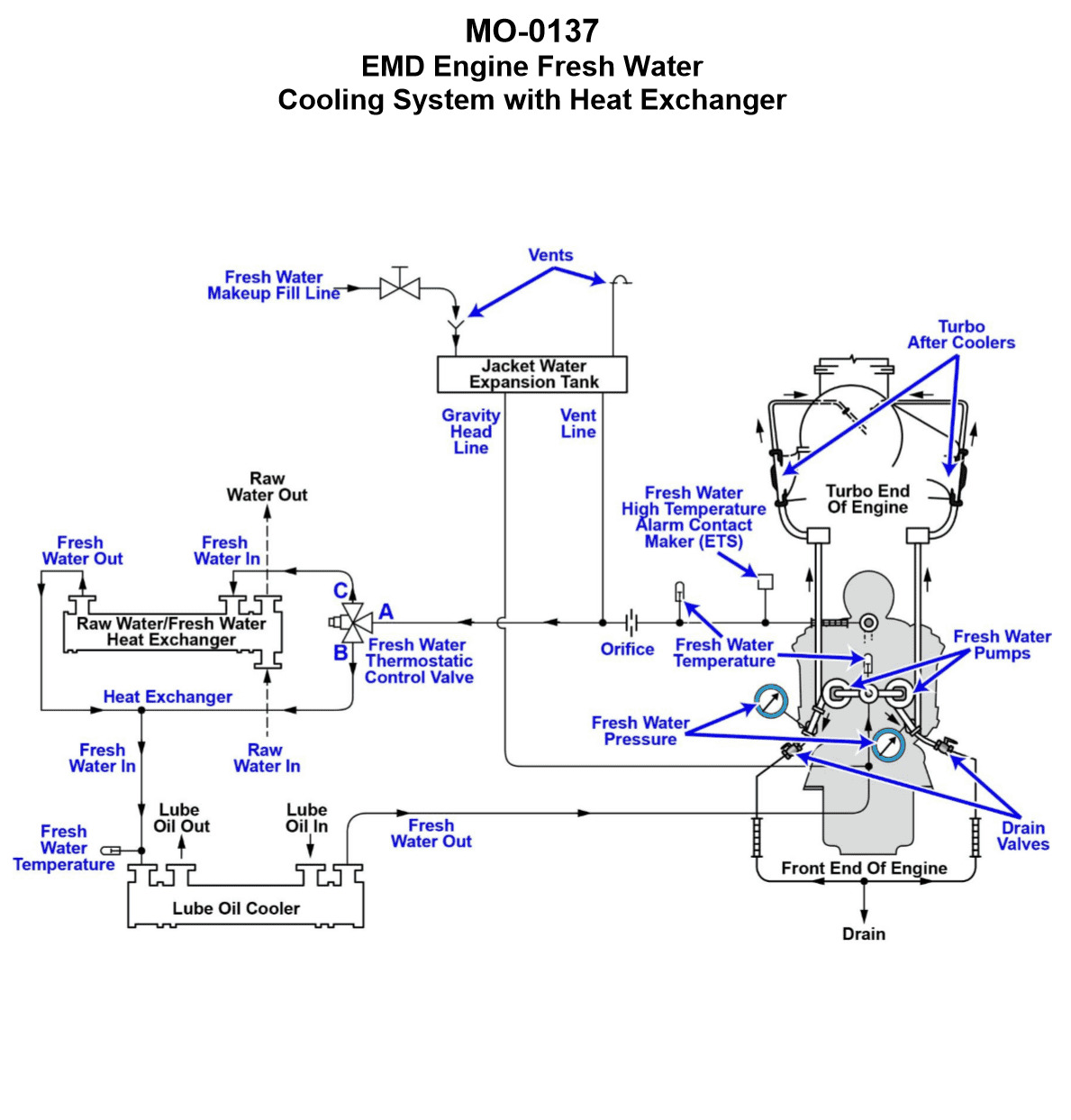
The Correct Answer is B ### 2. Explanation for Option B (Correct) **Option B: With no load, the engine would require a relatively normal time frame to warm up.** This scenario describes a failure where the freshwater thermostatic control valve is stuck, diverting 100% of the jacket water through the cooler circuit (flange "A" to "B"), effectively eliminating the bypass/recirculation path (flange "C" blocked). When a diesel engine is operating at **no load** (idling or starting), it generates very little heat. The vast majority of the time required for warm-up is spent heating the immense thermal mass of the engine block, components, and the static volume of the cooling fluid itself. Even though the cooling water is constantly being circulated through the main heat exchanger or radiator (which is designed to dissipate heat generated at maximum load), the amount of heat the engine is generating at idle is minimal. The rate of heat dissipation through the oversized cooler will be low because the temperature difference ($\Delta$T) between the jacket water and the cooling medium (air or seawater) is small. Consequently, while the valve failure technically attempts to cool the system prematurely, the extremely low heat input during a no-load warm-up means that the overall time taken to raise the temperature of the engine's thermal mass will be largely unaffected, resulting in a time frame perceived as relatively normal. ### 3. Explanation for Incorrect Options **A) With no load, the engine would require a much shorter than normal time frame to warm up.** This is incorrect. Forcing 100% of the flow through the main cooler (heat exchanger/radiator) maximizes heat removal from the system. Removing heat cannot shorten the time required to raise the temperature of the engine components and cooling water. **C) With no load, it is not possible to describe the time frame required to warm up the engine.** This is incorrect. We can analyze the thermal dynamics. Since the engine is running at a known, low heat output (idle/no load), and the thermal mass is constant, the resulting warm-up time can be described based on the low heat transfer efficiency of the oversized cooler under low heat load conditions. **D) With no load, the engine would require a much longer than normal time frame to warm up.** This would be the correct answer if the engine were operating under a **significant load**. Under high load, the engine generates substantial heat, and routing 100% of this heat through the cooler prevents the system from reaching or maintaining operating temperature, leading to slow warm-up or continuous under-cooling (too long/never warming up). However, under *no load*, the low heat generated means the forced cooling has a minimal impact on the overall process of heating the large mass, making the resulting warm-up time only slightly longer, but not significantly enough to be classified as "much longer than normal." Therefore, option B is the most accurate description of the no-load scenario.
Pass Your Coast Guard Licensing Exams!
Study offline, track your progress, and simulate real exams with the Coast Guard Exams app