Question 36 CEL02 - Chief Engineer - Limited (Alt)
As shown in figure "A" of the illustration, with respect to the common equipment grounding conductor, what statement is true? Illustration EL-0125
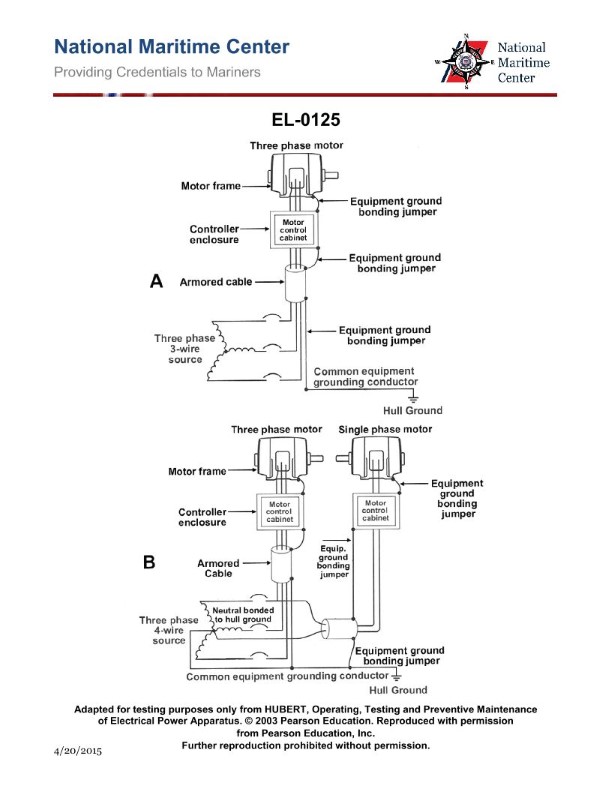
The Correct Answer is D **Explanation for Option D (Correct Answer):** Option D is correct because it accurately describes the standard practice for grounding systems on most merchant vessels. 1. **The common equipment grounding conductor is insulated from the source (isolated):** Unlike land-based facilities (which typically use solidly grounded neutrals/grounds), marine power systems often operate as **ungrounded systems** (or high-impedance grounded systems) for the primary power conductors (L1, L2, L3). This isolation is critical for maintaining service continuity. If an ungrounded system experiences a single phase-to-hull (ground) fault, the system can continue to operate temporarily. If the equipment grounding conductor (which connects all metallic equipment enclosures) were solidly tied to the source neutral or ground, it would defeat the isolation benefits and potentially lead to nuisance tripping or complex fault isolation. Therefore, the hull/earth ground connection (the equipment grounding conductor) is kept separate from the source neutral/ground points, effectively insulating the source conductors from ground under normal operating conditions. 2. **This is the most common arrangement onboard merchant vessels:** The safety of operations and continuous power supply are paramount at sea. Operating an ungrounded system (or an impedance-grounded system) is standard practice globally for marine applications because it prevents the first accidental ground fault from immediately causing system shutdown, allowing time for diagnosis and repair. **Explanation of Incorrect Options:** **A) The common equipment grounding conductor is solidly grounded at the source and this is the most common arrangement onboard merchant vessels.** * **Incorrect:** Solid grounding at the source for the main power system is generally avoided on merchant vessels. A solid ground connection means that any single phase-to-hull fault would immediately become a short circuit, causing the protective device (breaker) to trip and shutting down critical loads. This unacceptable loss of power is why isolated (ungrounded) systems are preferred. **B) The common equipment grounding conductor is solidly grounded at the source and this is the least common arrangement onboard merchant vessels.** * **Incorrect:** While solid grounding is the least common arrangement for the primary power system, the statement incorrectly implies that the *equipment grounding conductor* (EGC) itself is tied to a solidly grounded source neutral/ground. The main issue is the nature of the system grounding (it's isolated/insulated), not the commonality ranking. **C) The common equipment grounding conductor is insulated from the source and this is the least common arrangement onboard merchant vessels.** * **Incorrect:** This option correctly states that the equipment grounding conductor is insulated from the source, but it incorrectly claims this arrangement is the *least common*. As established, system isolation/insulation is the **most common** arrangement for marine power systems.
Pass Your Coast Guard Licensing Exams!
Study offline, track your progress, and simulate real exams with the Coast Guard Exams app