Question 18 CEL02 - Chief Engineer - Limited (Alt)
As shown in figures "A", "B", and "C" of the illustration, what is the purpose of the regenerating mode when transitioning from ahead to astern operation with a fixed-pitch propeller as driven by an AC synchronous propulsion motor? Illustration EL-0162
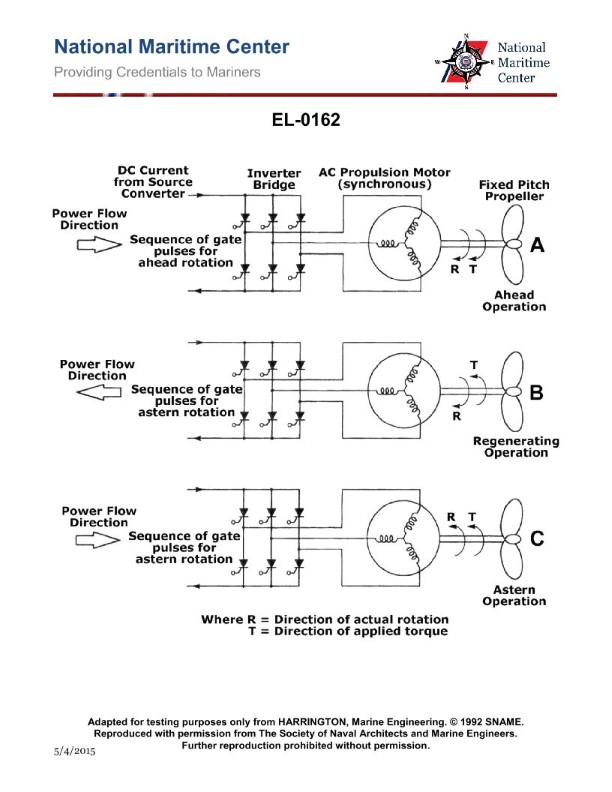
The Correct Answer is C **Explanation for C (Correct Option):** When an AC synchronous propulsion motor is driving a fixed-pitch propeller and the operation is transitioning from "ahead" (forward motion) to "astern" (reverse motion), the propeller shaft must first be brought to a complete stop and then accelerated in the opposite direction. The regenerating mode (often referred to as regenerative braking) uses the large kinetic energy (inertia) stored in the rotating propeller and shaft. By controlling the frequency and excitation of the synchronous motor (now acting as a generator), this mechanical energy is converted back into electrical energy and fed into the ship’s power system (or dissipated through resistors). This process provides a highly effective and controlled method of decelerating the shaft quickly and efficiently to a complete stop *before* the motor is commanded to accelerate in reverse. **Explanation of Why Other Options are Incorrect:** * **A) It allows regenerative acceleration to accelerate the shaft after the reversal of direction has taken place.** * Regeneration (regenerative braking) is a deceleration process (slowing down), not an acceleration process. Acceleration in the reverse direction requires motoring (consuming power), not regeneration (producing power). * **B) It allows the shaft to use inertia to very gradually slow down to a stop before reversing direction.** * While inertia is involved, the purpose of **regenerative braking** is specifically to slow the shaft down *quickly* and *controllably*, converting the inertia into useful electrical energy, rather than relying solely on gradual, passive slowing (which would take much longer). * **D) It allows the shaft to instantly reverse directions with virtually no slow down period.** * It is physically impossible and electrically destructive to instantly reverse a massive rotating shaft driven by a synchronous motor, especially when the propeller is still pushing water in the forward direction. Regenerative braking is employed precisely because a controlled slow-down and stop is mandatory before reversal.
Pass Your Coast Guard Licensing Exams!
Study offline, track your progress, and simulate real exams with the Coast Guard Exams app