Question 1 AEL01 - Assistant Engineer - Limited
The pressure-volume diagrams illustrated are of four internal combustion engine cycles. Which one represents the theoretical diesel cycle? Illustration MO-0102
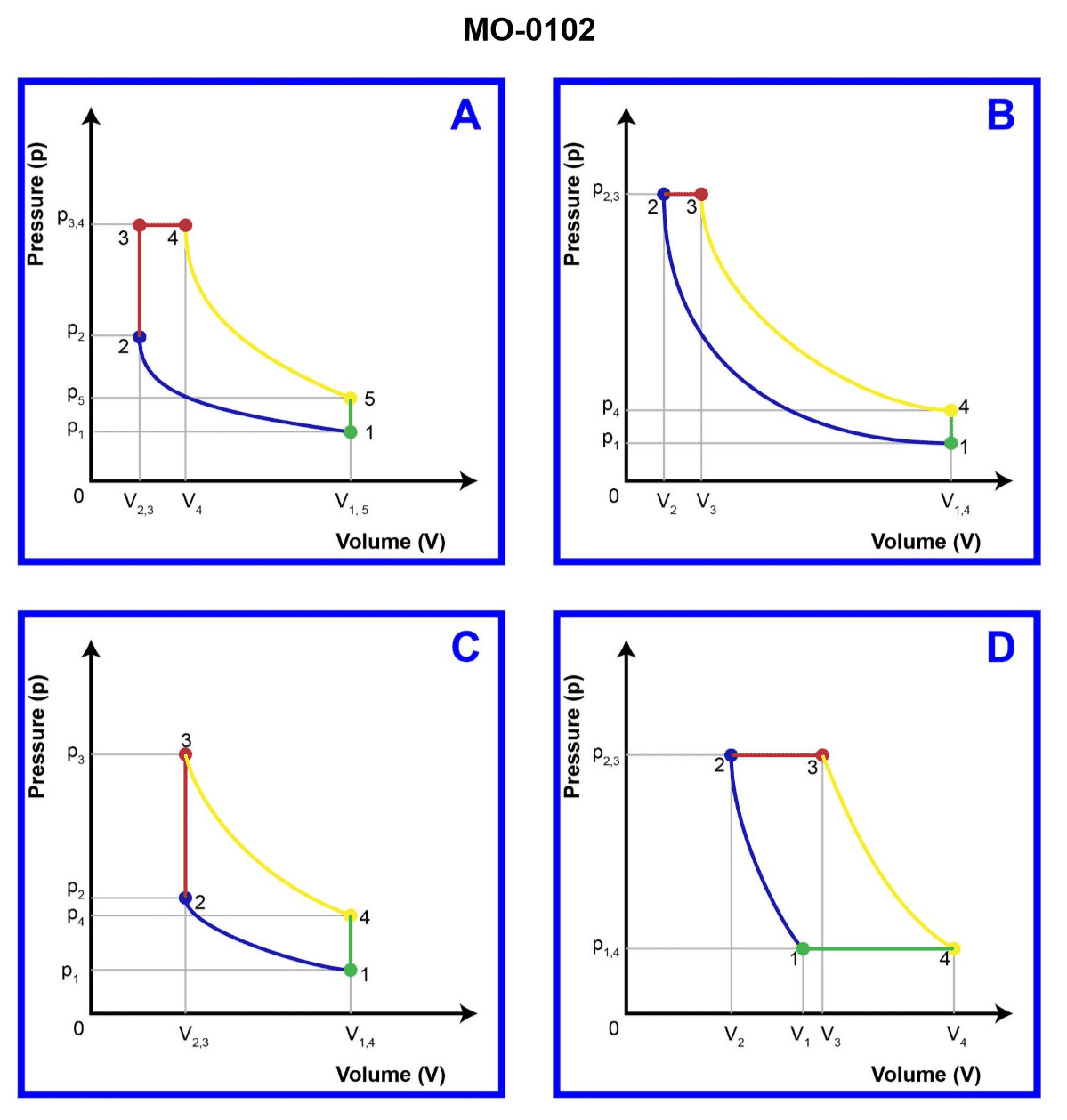
The Correct Answer is B ### Why Option B ("B") is Correct: Option B represents the theoretical Diesel cycle (also known as the compression-ignition cycle). The key characteristic distinguishing the Diesel cycle from the Otto cycle is the heat addition phase: 1. **Process 1-2 (Isentropic Compression):** Air is compressed rapidly (represented by a steep curve). 2. **Process 2-3 (Constant Pressure Heat Addition):** Fuel injection occurs near Top Dead Center (TDC), and combustion happens while the piston moves away from TDC. This heat addition occurs at **constant pressure ($P$)** as the volume increases ($\text{V}_2$ to $\text{V}_3$). This flat, horizontal line segment (2-3) on the P-V diagram is the defining feature of the ideal Diesel cycle. 3. **Process 3-4 (Isentropic Expansion/Power Stroke):** The hot gases expand, driving the piston (work output). 4. **Process 4-1 (Constant Volume Heat Rejection):** Exhaust valve opens, and heat is rejected instantaneously at **constant volume ($V$)** (represented by a vertical line). ### Why the Other Options are Incorrect: * **Option A (Otto Cycle):** This cycle represents the theoretical Otto cycle (spark-ignition engine). Its defining characteristic is the heat addition phase (2-3) occurring at **constant volume ($\text{V}$) (a vertical line)**, which is fundamentally different from the Diesel cycle's constant pressure heat addition. * **Option C (Brayton Cycle):** This cycle is used for gas turbines and jet engines. The key distinguishing feature is that both heat addition (2-3) and heat rejection (4-1) occur at **constant pressure ($P$) (two horizontal lines)**, rather than constant volume. * **Option D (Dual Cycle or Mixed Cycle):** This cycle is a theoretical representation that combines aspects of both the Otto and Diesel cycles, making it the most accurate model for real modern internal combustion engines. Heat addition (2-3) occurs partly at **constant volume (vertical line)** and partly at **constant pressure (horizontal line)**.
Pass Your Coast Guard Licensing Exams!
Study offline, track your progress, and simulate real exams with the Coast Guard Exams app