Question 9 3AE02 - Third Assistant Engineer (Alt)
Referring to the illustration, note that the solenoid in line "C" is closed. The check valve in line "E" is open. The separator service pump is running. The check valve in line "G" is closed. Valve "B" is closed. Valve "D" is open. What is the operational status of the oily-water separator unit? Illustration GS-0175
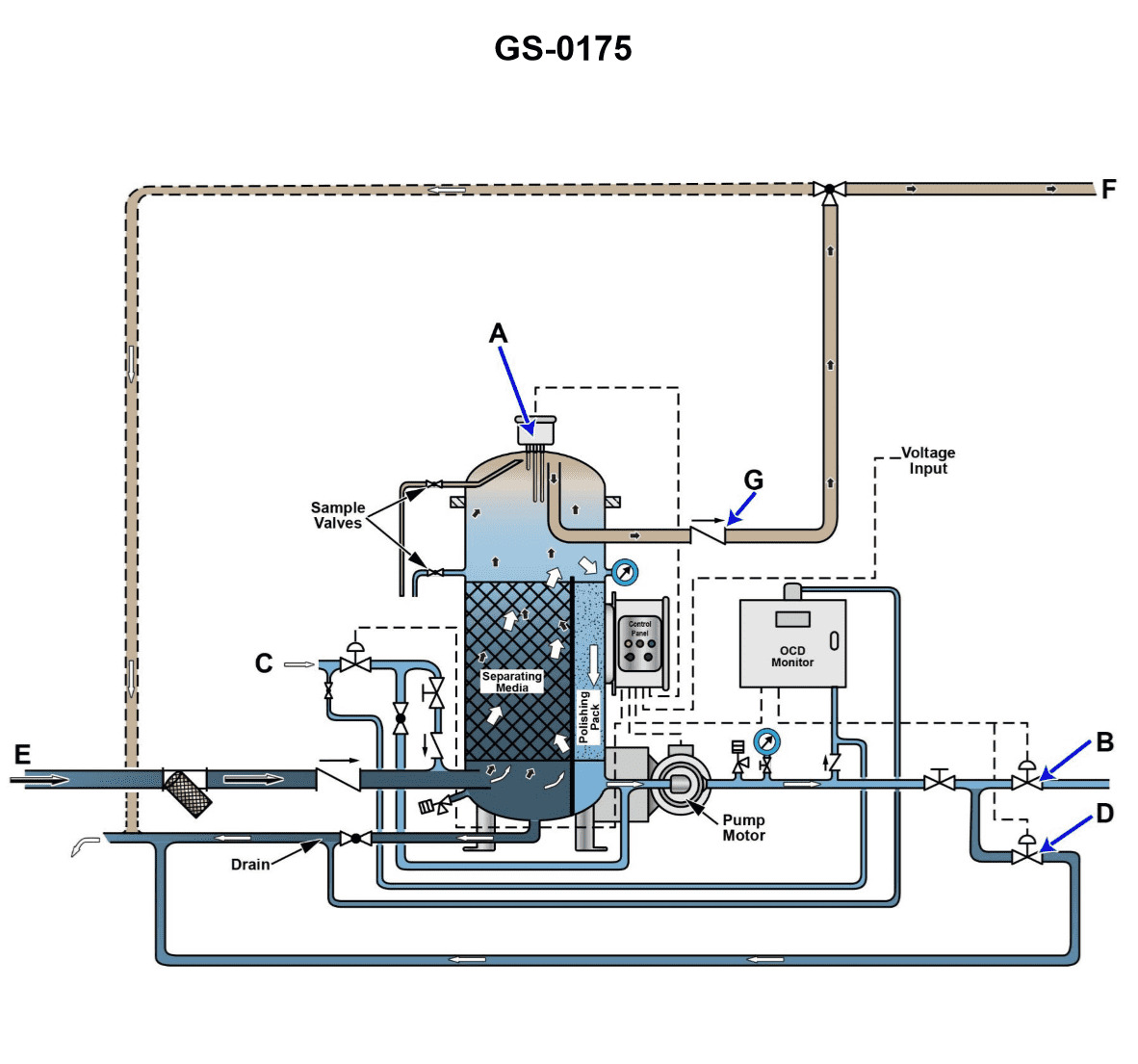
The Correct Answer is C ### Explanation of Why Option C is Correct Option C states: "The oily-water separator is in the bilge water separation processing mode with water discharging back to the bilge water holding tank with an oil content greater than 15 ppm." 1. **Processing Mode Confirmation:** The separator service pump is running, which confirms the Oily-Water Separator (OWS) is actively operating and processing bilge water. 2. **Discharge Path Determination (Recirculation):** In standard OWS operation, the status of the overboard discharge valve (often related to line G) and the recirculation valve (often related to line E) determines the flow path. * The check valve in line "G" (typically the final overboard discharge line) is **closed**. This immediately prevents discharge overboard. * The check valve in line "E" (typically the recirculation/return path to the bilge tank) is **open**. * Because the overboard path (G) is closed and the return path (E) is open, the effluent water is being diverted back to the bilge water holding tank (recirculation). 3. **15 ppm Determination:** Recirculation is the automatic safety response mandated by the 15 ppm monitoring system. If the OWS effluent fails to meet the legal discharge standard (i.e., the oil content is **greater than 15 ppm**), the monitor commands the overboard valve to close (G closes) and opens the recirculation valve (E opens) to ensure no contaminated water is released. Therefore, the system is processing bilge water, and the resulting high oil content (> 15 ppm) is causing the effluent to be routed back to the bilge tank. --- ### Why Other Options Are Incorrect **A) The oily-water separator is in the bilge water separation processing mode with water discharging back to the bilge water holding tank with an oil content less than 15 ppm.** * **Incorrect:** Recirculation back to the holding tank only occurs when the oil content is *unacceptable* (greater than 15 ppm). If the oil content were less than 15 ppm, the system would attempt to discharge overboard. **B) The oily-water separator is in the bilge water separation processing mode with water discharging overboard with an oil content greater than 15 ppm.** * **Incorrect:** Two critical points are violated: * Discharge overboard is impossible because the overboard valve (G) is **closed**. * It is illegal and operationally impossible for the OWS system to discharge overboard when the oil content is greater than 15 ppm. **D) The oily-water separator is in the bilge water separation processing mode with water discharging overboard with an oil content less than 15 ppm.** * **Incorrect:** While this scenario describes a safe operational state (< 15 ppm), the valve status does not support overboard discharge. Overboard discharge requires valve G to be **open**, but the conditions state valve G is **closed**. Furthermore, the recirculation path E is open, confirming recirculation, not overboard discharge.
Pass Your Coast Guard Licensing Exams!
Study offline, track your progress, and simulate real exams with the Coast Guard Exams app