Question 23 3AE02 - Third Assistant Engineer (Alt)
In the illustrated self-contained, internal-pilot, piston-operated temperature control valve, what statement is true concerning the pilot and main valves? Illustration GS-0045
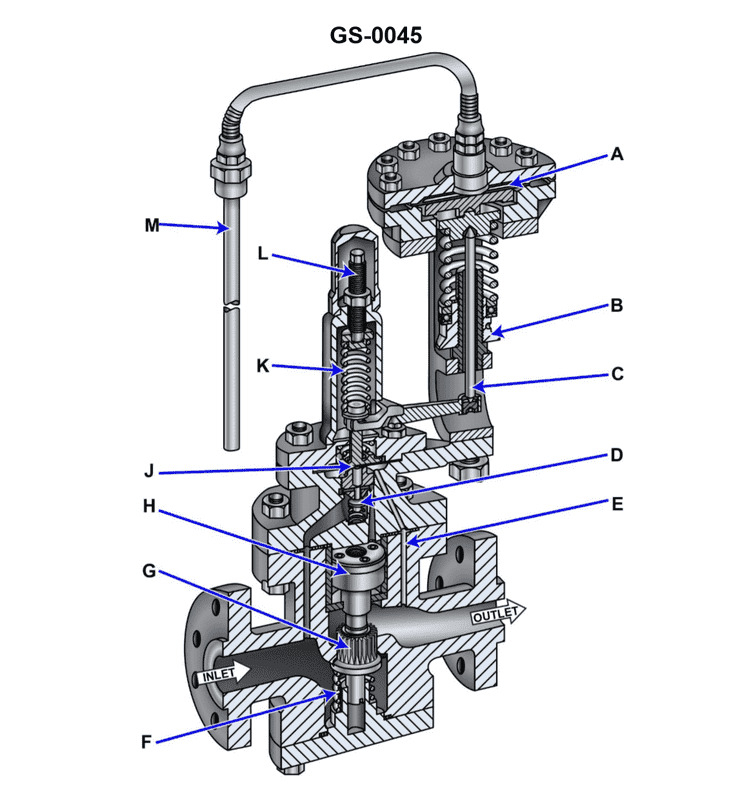
The Correct Answer is B **Explanation for Option B (Correct Answer):** The temperature control valve described is an internal-pilot, piston-operated valve. This type of valve typically uses the pressure of the working fluid (e.g., steam or water) to assist in opening the main valve. 1. **Pilot Valve (Upward Seating):** The pilot valve is usually designed to be upward seating (it opens by moving upward, away from its seat) because this configuration allows the upstream pressure (inlet pressure) acting on the underside of the pilot disc to assist in opening the pilot valve when the control element (like a bellows or diaphragm) commands an increase in temperature/flow. When the pilot valve opens, it vents pressure from the chamber above the main piston, allowing the main valve to open. 2. **Main Valve (Upward Seating):** The main valve is also typically upward seating in internal-pilot piston-operated designs. In this configuration, the upstream pressure acts on the underside of the main valve disc. This upstream pressure is the force used to lift the main valve (piston assembly) off its seat once the pressure above the piston has been relieved by the pilot valve. If the main valve were downward seating, the upstream pressure would force it closed, requiring a massive external spring or actuator to overcome the pressure differential, which defeats the purpose of an internal-pilot, pressure-assisted design. Therefore, both the pilot and main valves utilize an upward seating design to take advantage of the inlet fluid pressure for operation. **(Note: While Illustration GS-0045 is not provided, the operational principles of standard self-contained, internal-pilot valves strongly dictate this upward-seating configuration for both valves.)** **Explanation of Incorrect Options:** * **A) The pilot valve is downward seating and the main valve is upward seating:** This is incorrect because the pilot valve is generally upward seating to utilize upstream pressure to assist in its opening action and ensure proper pressure balancing for the pilot function. * **C) The pilot valve is upward seating and the main valve is downward seating:** This is incorrect because if the main valve were downward seating, the full inlet pressure acting on top of the valve disc would hold it shut. The internal pilot pressure relief mechanism would be unable to open the valve without overcoming this significant static pressure, making the valve impractical for pressure-assisted operation. * **D) The pilot valve is downward seating and the main valve is downward seating:** This is incorrect for the reasons stated above; neither valve typically uses a downward seating arrangement in this self-contained, pressure-assisted design.
Pass Your Coast Guard Licensing Exams!
Study offline, track your progress, and simulate real exams with the Coast Guard Exams app