Question 6 3AE02 - Third Assistant Engineer (Alt)
Which of the conditions listed would indicate a large condenser tube leak within the distiller shown in the illustration? Illustration MO-0111
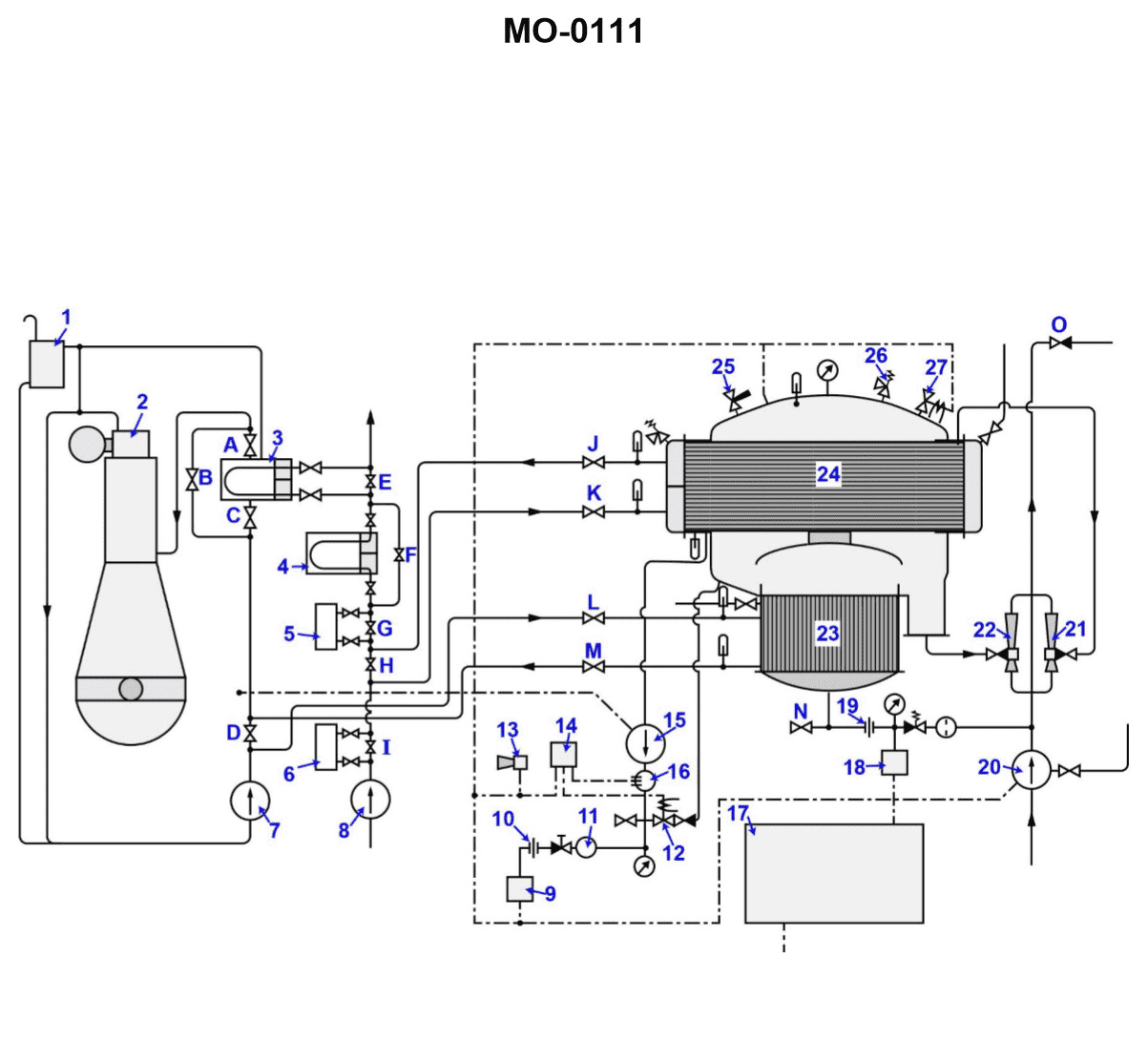
The Correct Answer is A **Explanation of Option A (Correct Answer):** A large condenser tube leak in a ship's distilling plant (evaporator or distiller) typically allows the circulating seawater (which is used as the cooling medium in the condenser) to mix with the freshwater distillate (the product water). Seawater has a high salt content (salinity), while the desired product water must have extremely low salinity to be suitable for boiler feedwater or potable use. The salinity monitoring equipment is specifically designed to continuously sample and test the product water. If a large condenser leak occurs, the influx of seawater will immediately and dramatically increase the salinity of the distillate, triggering the monitor's alarm (annunciator circuit) to warn the operator that the product water is contaminated and must be dumped. **Explanation of Other Options (Incorrect):** * **B) A slow continuous rise in the lube oil cooler outlet temperature indicated at device "4":** This condition indicates a problem with the lube oil cooler, such as fouling or reduced flow of the cooling medium (likely seawater or jacket water) to the cooler. It has no direct or primary link to a leak within the condenser tubes of the distilling unit. * **C) A decrease in the level of the main engine expansion tank as indicated by a low-level alarm:** This indicates a leak in the main engine's closed jacket water cooling system. The condenser in many distillers uses jacket water as the heat source for evaporation, but a leak in the *distiller condenser* (where steam is condensed into freshwater) does not draw water from the engine expansion tank. Furthermore, a leak within the *distiller* itself would usually result in contamination of the distillate, not a loss of jacket water detectable at the expansion tank (unless the jacket water was leaking *into* the vacuum space, but the primary indicator of a condenser leak is salinity). * **D) An increase in distiller output resulting from the combination of jacket water and the distillate produced:** Distiller output (distillate) is product water. Jacket water is the heat source. They are separate fluids. If a leak occurred that allowed jacket water to mix with distillate, the *total* volume might increase, but this is a secondary effect and would still be detected primarily as contamination (perhaps glycol or treatment chemicals from the jacket water) rather than a simple *increase* in output. The defining characteristic of a large *condenser* leak (which uses seawater as coolant) is the immediate and dramatic **salinity increase**, not just a volume change.
Pass Your Coast Guard Licensing Exams!
Study offline, track your progress, and simulate real exams with the Coast Guard Exams app