Question 3 3AE02 - Third Assistant Engineer (Alt)
The device shown in the illustration is being used to control the output of an axial piston pump. "T" is the exhaust to pump casing. "P" is the supply from the replenishing pump. What will happen when part "3" is moved to the left? Illustration GS-0039
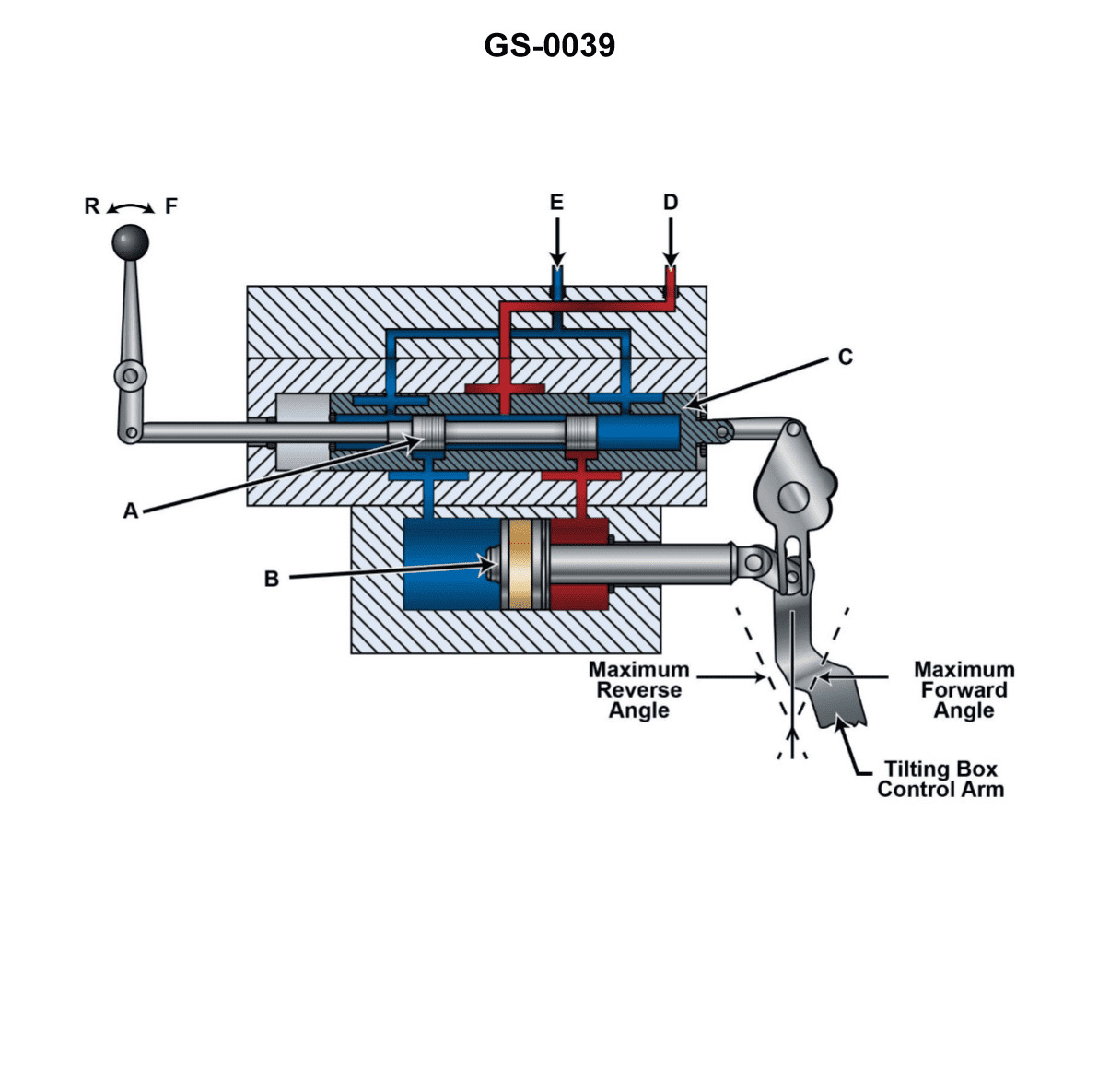
The Correct Answer is A ### 2. Explanation of Why Option A is Correct This device illustrates a basic follow-up servo control mechanism used in many variable displacement pumps to regulate output via a swash plate. The control sequence depends on the interaction between the input (3), the main spool valve (2), and the power piston (1). 1. **Input Action (Part 3):** When the input position (3) is moved to the left, it acts through a mechanical linkage (often a lever system) to displace the main spool valve (2). Due to the linkage design typical in these compensators, the movement of (3) to the left causes the spool (2) to move to the **right**. 2. **Spool Valve Action (Part 2):** The movement of spool (2) to the right opens the internal passages. High-pressure supply (P) is directed to one side of the power piston (1) (likely the right side), while the fluid on the opposite side of the piston (1) (the left side) is connected to the low-pressure drain (T, exhaust to pump casing). 3. **Piston Movement (Part 1):** The resulting pressure differential forces the power piston (1) to move to the **left**, which in turn adjusts the angle of the pump swash plate, changing the pump output. 4. **Feedback and Lag:** Component (1) is linked back to the spool (2) via a follow-up linkage. As (1) moves left, it provides feedback that pushes spool (2) back toward its neutral (centered) position, thereby cutting off the flow of pressurized fluid. This process ensures stability and accurate positioning. Therefore, the movement of the resulting actuator (1) to the left *lags behind* the initial input movement (3) because (1) must physically move far enough to recenter the spool (2) and stop its own movement. The required sequence is: Input (3) Left $\rightarrow$ Spool (2) Right $\rightarrow$ Piston (1) Left, stabilizing the mechanism by recentering (2). ### 3. Explanation of Why Other Options Are Incorrect **B) "2" will move to the left, and "1" will move to the right, but lagging behind "2"** * This is incorrect because the movement of (3) to the left typically results in (2) moving to the right (due to the lever action). Additionally, in a servo system, the spool (2) and the piston (1) generally move in opposite directions to achieve the required feedback. **C) "2" will move to the left, as will "1"** * This is incorrect for two reasons. First, the spool (2) and piston (1) must move in opposite directions for the follow-up linkage to function (if they moved in the same direction, the system would destabilize). Second, this option implies instantaneous, non-feedback movement, which is not how this closed-loop servo mechanism operates. **D) "2" will move to the right, as will "1"** * This is incorrect because spool (2) and piston (1) must move in opposite directions for the feedback control to work effectively. If both moved right, the system would not stabilize at the desired position determined by input (3).
Pass Your Coast Guard Licensing Exams!
Study offline, track your progress, and simulate real exams with the Coast Guard Exams app