Question 6 3AE01 - Third Assistant Engineer
Which of the following conditions would NOT be considered a valid reason for the diesel engine to operate in the area indicated by letter "B" shown in the illustration? Illustration MO-0126
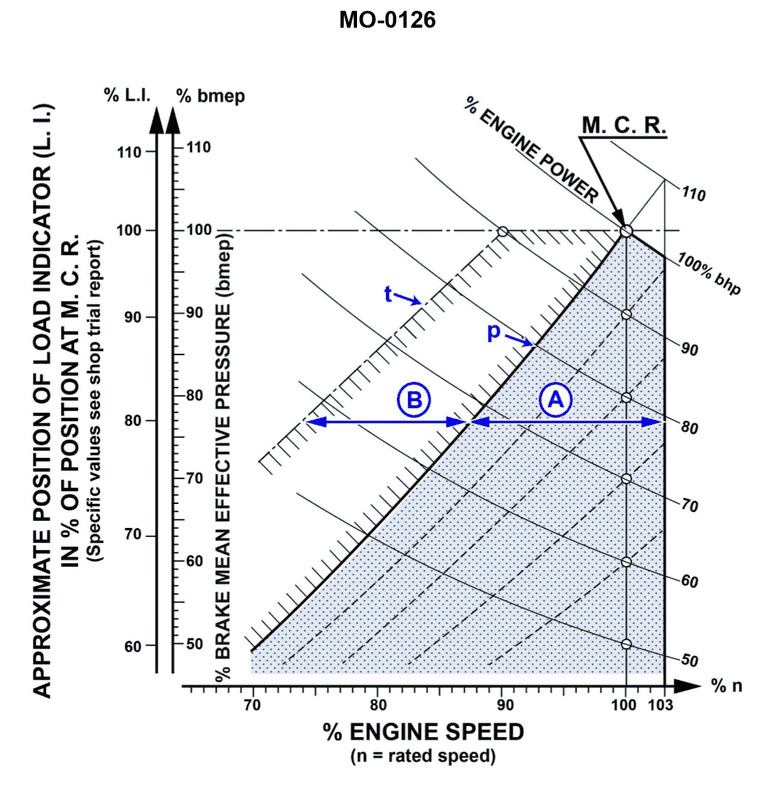
The Correct Answer is D ### 2. Explanation of Why Option D is Correct Option D, **"Operating with minimal hull drag and under light draft,"** describes conditions of **low external resistance and light loading**. When a vessel experiences minimal hull drag (clean hull) and is in light draft (less displacement), the engine experiences less resistance from the water. * **Engine Performance:** Under these light conditions, the engine will be able to achieve higher revolutions per minute (RPM) for a given power setting, and the overall load on the engine will be low. * **Operational Area "B" Inference:** Operation in area "B" on typical marine engine illustrations (especially when defined by external conditions like A, B, and C) usually indicates high-load, heavy-running, or potentially overloaded conditions (lugging) caused by excessive resistance. * **Conclusion:** Since minimal drag/light draft results in *low* load, this condition would cause the engine to operate outside of (or below) the heavy-load area "B." Therefore, operating with minimal hull drag and under light draft is **NOT** a valid reason for the diesel engine to operate in the high-resistance/high-load area indicated by letter "B." ### 3. Explanation of Why Other Options Are Incorrect Options A, B, and C are all conditions that significantly **increase the external resistance (load)** on the vessel and the propeller, making them valid reasons for the engine to operate in the high-load/heavy-running region (Area B). * **A) Operating the vessel against high winds and current:** High winds and strong opposing currents create extreme resistance. This increased resistance requires the engine to generate higher torque (load) to maintain speed, often resulting in "lugging"—running at high load and potentially lower-than-optimal RPM. This is a valid reason for the engine to operate in area "B." * **B) Operating the vessel in shallow water:** Shallow water increases hydrodynamic resistance due to squat, increased wave-making resistance, and restricted flow. This significantly increases the load on the engine, forcing it into a heavy-running condition. This is a valid reason for the engine to operate in area "B." * **C) Operating with a fouled or damaged propeller:** A propeller that is fouled (covered in marine growth) or damaged is highly inefficient. To absorb the power and achieve desired thrust, the engine must overcome this massive propeller inefficiency, resulting in a severe overloading condition (very high torque demand). This is a valid reason for the engine to operate in area "B."
Pass Your Coast Guard Licensing Exams!
Study offline, track your progress, and simulate real exams with the Coast Guard Exams app