Question 14Electricity & Electronics - 1st Asst/Chief
70% to passAs shown in figure "C" of the illustration, what are the purposes of the coupling capacitor Cc and the bypass capacitor Cbp respectively? Illustration EL-0045
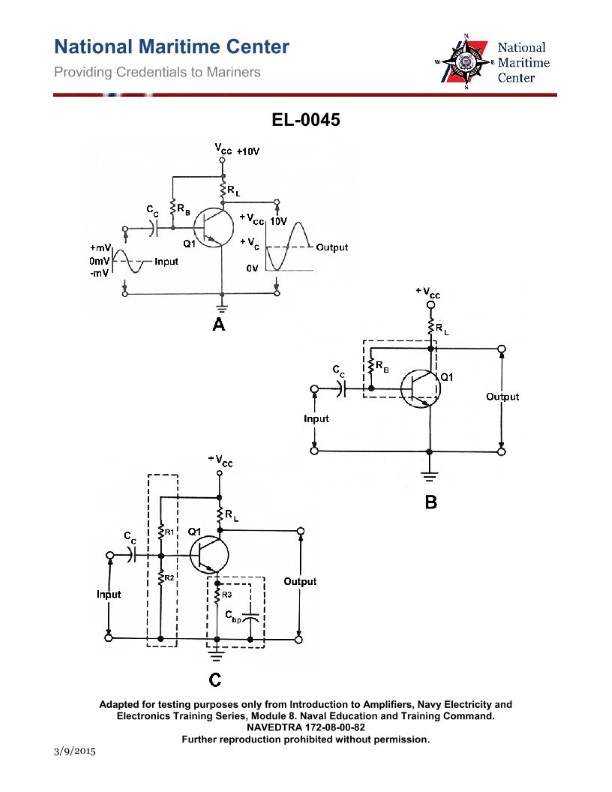
The correct answer is C. The coupling capacitor Cc blocks any DC component associated with the input from reaching the base of the transistor, while the bypass capacitor Cbp helps minimize degeneration of the AC output signal. This configuration is commonly used in amplifier circuits to isolate the DC bias conditions from the AC signal path, ensuring stable and efficient amplification of the input signal. The other options are incorrect because: A) Cc blocks DC, not AC, from reaching the base. B) Cbp helps minimize, not maximize, degeneration of the AC output signal. D) Cc blocks DC, not AC, from reaching the base, and Cbp helps minimize, not maximize, degeneration of the AC output signal.
Ready to test your knowledge?
Take a Electricity & Electronics - 1st Asst/Chief Practice ExamPass Your Coast Guard Licensing Exams!
Study offline, track your progress, and simulate real exams with the Coast Guard Exams app