Question 28 UFV02 - Mate - Uninspected Fishing Vessels
INLAND ONLY Vessels "A" and "B" are meeting on a river as shown in illustration D041RR below and will pass 1/4 mile apart. Which is one of the lights on vessel "B" that you will see if you are on vessel "A"?
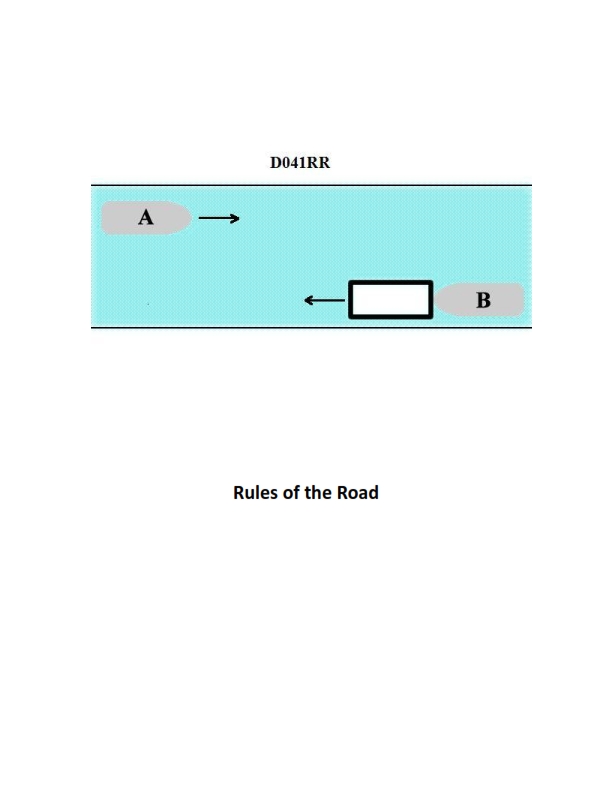
The Correct Answer is C ### Explanation for C (special flashing light) Vessel "B" is shown pushing ahead or towing alongside an arrangement of barges/vessels (indicated by the configuration and the description of the scenario as typical inland meeting). On U.S. Inland Waters, a power-driven vessel engaged in pushing ahead or towing alongside, when operating on the Great Lakes, Western Rivers, or **any other waters designated by the Secretary of the Department in which the Coast Guard is operating**, must exhibit a **special flashing light** (Rule 24(j) of the Inland Rules, which superseded the former Rule 24(i) and is often referred to in contexts covering Western Rivers and similar designated waters). This light is a yellow light, flashing at a frequency of 50 to 70 flashes per minute, placed as far forward as possible, visible all around the horizon. Since Vessel B is towing/pushing on a river (Inland Only), the special flashing light is one of the mandatory lights it must display, and thus one that Vessel A will see. ### Explanations for Incorrect Options **A) yellow towing light:** This option is incorrect because the term "yellow towing light" typically refers to the fixed yellow stern light (often called the after masthead light or towing light) required under the International Rules (Rule 24(a)(i)) and Inland Rules (Rule 24(a)(i)) for vessels *towing astern*. However, Vessel B is engaged in pushing ahead or towing alongside on Inland Waters. For pushing ahead/towing alongside on Western Rivers/designated waters, the towing vessel exhibits the standard masthead lights (two or three, depending on length of tow) and the mandatory side lights, but the distinct yellow towing light shown high on the stern for towing *astern* is not displayed in this configuration. More importantly, the required special signal for this specific type of inland tow is the **special flashing light** (Option C). **B) red sidelight:** This option is incorrect based on the relative positions shown in the illustration (D041RR, which typically shows a head-on meeting scenario). If Vessel A is meeting Vessel B head-on (or nearly head-on), Vessel A will see the vessel's forward-facing lights (masthead lights) and both sidelights (red on port, green on starboard), or possibly only the green sidelight if Vessel B is slightly to starboard. Since the vessels are meeting and passing 1/4 mile apart, they are likely passing port-to-port. If they are passing port-to-port, Vessel A will see Vessel B's **green** (starboard) sidelight, not its **red** (port) sidelight, as the red light will be facing away or obscured from A's perspective. Therefore, "red sidelight" is not guaranteed to be seen, and is likely incorrect for a typical meeting/passing maneuver. **D) All of the above:** Since options A and B are incorrect, this option is also incorrect.
Pass Your Coast Guard Licensing Exams!
Study offline, track your progress, and simulate real exams with the Coast Guard Exams app