Question 13 TV03 - Towing Vessels - Western Rivers
INLAND ONLY Two power-driven vessels are meeting in a narrow channel on the Great Lakes as shown in illustration D037RR below. Vessel "A" is downbound with a following current. Vessel "A" shall do which of the following?
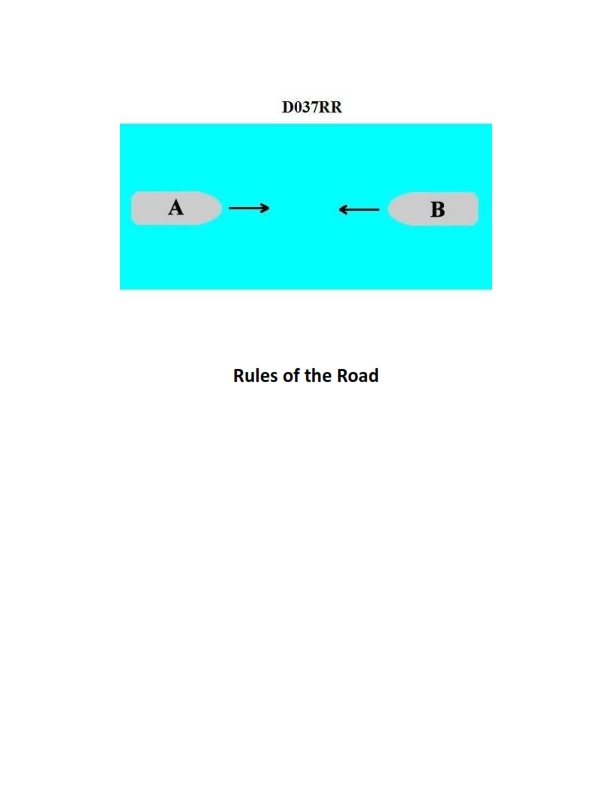
The Correct Answer is D **Explanation for Option D (All of the above):** The scenario describes two power-driven vessels meeting in a narrow channel on the Great Lakes, with Vessel "A" being **downbound** and having a **following current**. This situation is governed by the Inland Rules of the Road (specifically, Rule 9 - Narrow Channels) and the Inland Western Rivers Rules (which include specific provisions for vessels proceeding downbound with a current, applied to the Great Lakes and other non-Western River navigable waters through specific annexes or long-standing practice/interpretation related to navigation on rivers/channels). 1. **Propose the manner of passage (Option A):** Inland Rule 9(a)(ii) states that a vessel proceeding **downbound** with a following current shall have the right-of-way over an upbound vessel, and **shall propose the manner of passage**. This makes option A correct. 2. **Initiate the maneuvering signals (Option B):** Since Vessel A is required to propose the manner of passage, it must initiate the necessary whistle signals (maneuvering signals) to communicate its proposal (e.g., one short blast for port-to-port passage, two short blasts for starboard-to-starboard passage). This makes option B correct. 3. **Have the right of way (Option C):** As established by Inland Rule 9(a)(ii), the vessel proceeding downbound with a following current (Vessel A) **shall have the right-of-way**. This makes option C correct. Since all three individual statements (A, B, and C) are mandated actions for Vessel A under these specific circumstances, "All of the above" (D) is the correct answer. **Brief Explanation of Why Other Options are Incorrect (in the context of D being correct):** * **A) Propose the manner of passage:** While this is a true action Vessel A must take, it is incomplete because Vessel A must also initiate signals and has the right-of-way. It is not the *most* complete correct answer. * **B) Initiate the maneuvering signals:** While this is a true action Vessel A must take (as part of proposing passage), it is incomplete because Vessel A also proposes the passage and holds the right-of-way. * **C) Have the right of way:** While this is true regarding Vessel A's status, it is incomplete because Vessel A is also burdened with the duty to propose the manner of passage and initiate the signals.
Pass Your Coast Guard Licensing Exams!
Study offline, track your progress, and simulate real exams with the Coast Guard Exams app