Question 28 TV02 - Towing Vessels - Great Lakes and Inland
INLAND ONLY Vessels "A" and "B" are meeting on a river as shown in illustration D041RR below and will pass 1/4 mile apart. Which is one of the lights on vessel "B" that you will see if you are on vessel "A"?
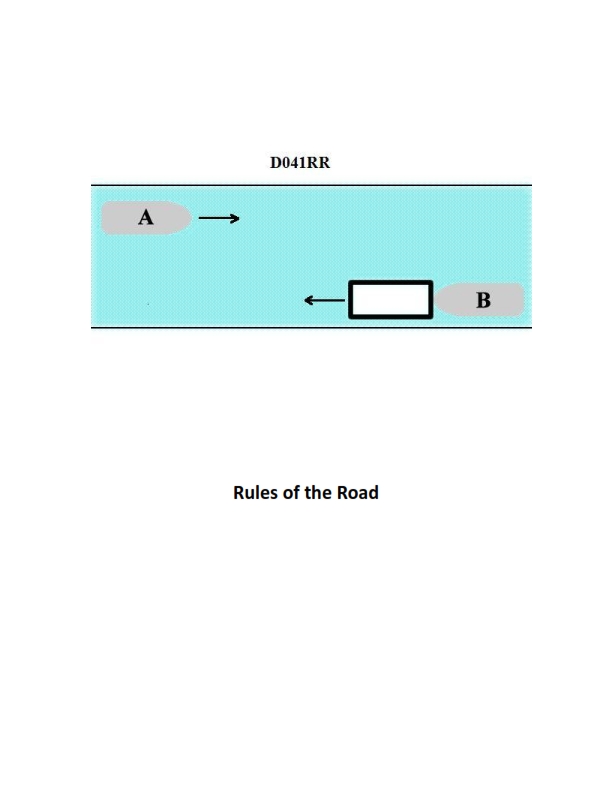
The Correct Answer is C ### Explanation for C (special flashing light) Vessel B is explicitly described as an **INLAND ONLY** vessel meeting another vessel on a river. If vessel B is required to display a special flashing light, it must be because it is a **pushing vessel in a composite unit** (where the tow is ahead and rigidly connected) or because it is a **vessel engaged in towing by pushing ahead, or hip-to-hip, that is not part of a composite unit**, and this light is mandatory under the Inland Rules (33 CFR § 84.156). The crucial aspect of the special flashing light (a yellow light flashing at 50-70 flashes per minute) is that it is displayed on the **forward mast** of the vessel doing the pushing or towing. Since vessel B is approaching vessel A head-on (or nearly head-on), the forward light, such as the special flashing light, would be one of the lights visible to vessel A. *(Note on the illustration D041RR, which is not provided but is standard training material: This illustration typically shows two power-driven vessels approaching each other, one of which is often involved in pushing or towing, making the special flashing light relevant under Inland Rules.)* ### Explanation for Why Other Options Are Incorrect **A) yellow towing light:** * Under the Inland Rules, the **yellow towing light** (displayed above the sternlight) is a mandatory light for a vessel engaged in towing, **but only when the tow is astern** (towing alongside or pushing does not require this specific light). * Since vessel B is approaching A, its stern would be pointed away. Therefore, vessel A would not see the yellow towing light (which is a stern-facing light) unless the vessel was passing or being overtaken. **B) red sidelight:** * The red sidelight is displayed on the port (left) side of the vessel. * In a meeting situation (head-on or nearly head-on), vessel A is positioned such that it would see vessel B's **green sidelight** (starboard/right side) and/or both sidelights if exactly head-on. If the vessels are passing 1/4 mile apart, they are likely passing port-to-port or starboard-to-starboard. * If vessel A is seeing the red sidelight of vessel B, it means vessel B is turning to its port (left), or vessel A is already significantly to vessel B's port side. In a standard meeting/passing scenario, especially if passing slightly to the starboard side (common practice), the green sidelight would be visible, but the red sidelight would be hidden from view by the vessel's structure. **D) All of the above:** * Since both options A and B are incorrect in a standard meeting scenario, this option cannot be correct.
Pass Your Coast Guard Licensing Exams!
Study offline, track your progress, and simulate real exams with the Coast Guard Exams app