Question 28 TV01 - Towing Vessels - Oceans or Near Coastal
INLAND ONLY Vessels "A" and "B" are meeting on a river as shown in illustration D041RR below and will pass 1/4 mile apart. Which is one of the lights on vessel "B" that you will see if you are on vessel "A"?
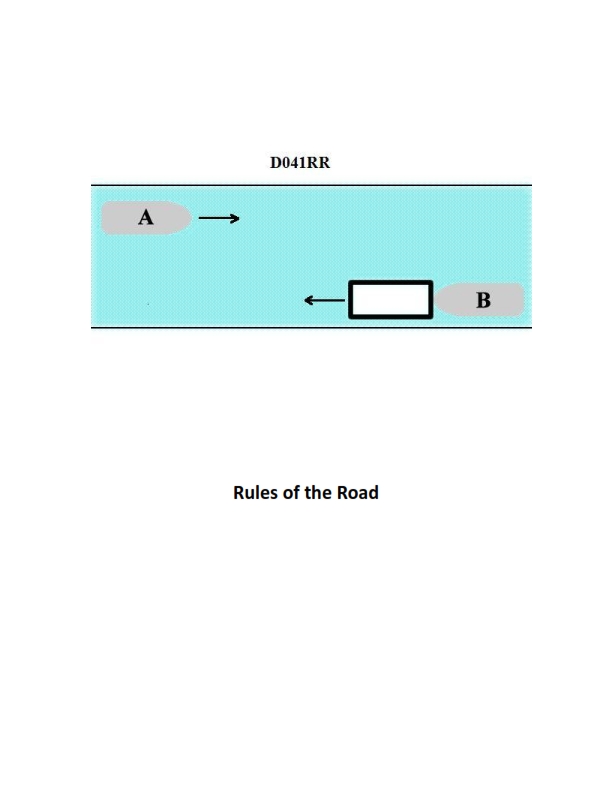
The Correct Answer is C ### 2. Explanation for Option C (special flashing light) Vessels meeting on an Inland river, particularly on the Western Rivers or specific U.S. waters, often involve large towing vessels pushing barges ahead. The **special flashing light** is a unique light mandated by Inland Rule 24(g) for a power-driven vessel when pushing ahead or alongside on the Western Rivers or other waters specified by the Commandant. This light is placed on the forward part of the vessel, is yellow, and flashes quickly (50-70 times per minute). Since Vessel B is operating on an inland river and is positioned for a meeting situation, it is highly likely to be a push-tow displaying this specific identifying light, which would be clearly visible to Vessel A. ### 3. Explanation for Incorrect Options **A) yellow towing light:** A yellow towing light (also known as a stern light for a towing vessel) is reserved for vessels towing **astern** (pulling a tow). A vessel that is pushing a tow ahead displays standard masthead lights and side lights, along with the special flashing light (C), but does not typically display the yellow towing light used for towing astern. Therefore, this light would likely not be on Vessel B if it is an Inland push-tow. **B) red sidelight:** While a red sidelight (port light) would technically be visible to Vessel A if Vessel B is approaching head-on or nearly head-on (as is common in a meeting situation), the question seeks one of the visible lights. The special flashing light (C) is the highly specific and unique light that defines the Inland push-tow operation, making it the intended answer distinguishing it from generic lights. Since this light is mandatory for the likely vessel B, and option A is incorrect, C is the most defining and correct answer specific to this Inland scenario. **D) All of the above:** Since the yellow towing light (A) is typically not used when pushing ahead, not all options are correct, ruling out D.
Pass Your Coast Guard Licensing Exams!
Study offline, track your progress, and simulate real exams with the Coast Guard Exams app