Question 10 TV01 - Towing Vessels - Oceans or Near Coastal
BOTH INTERNATIONAL & INLAND Vessel "A" is overtaking vessel "B" as shown in illustration D017RR below. Vessel "B" should do which of the following?
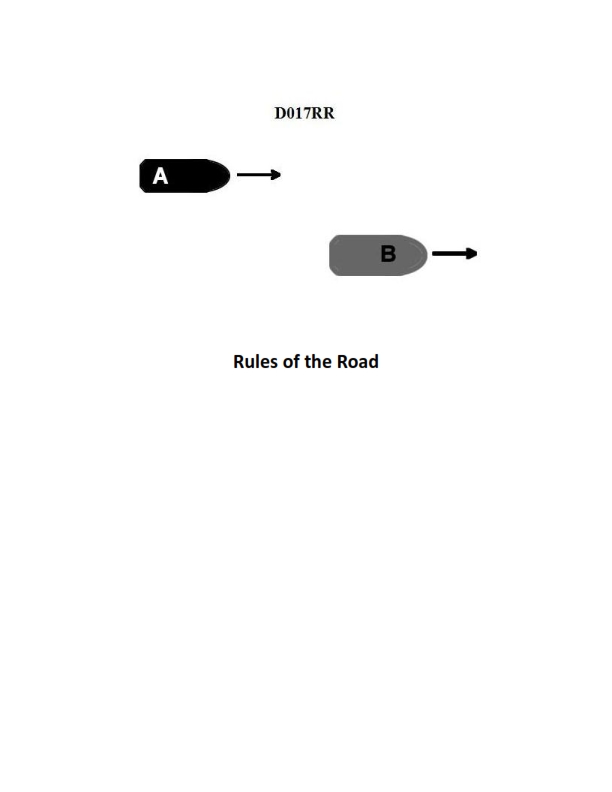
The Correct Answer is B **Explanation for Option B (Correct):** This scenario is governed by Rule 13 (Overtaking) and Rule 17 (Action by Stand-on Vessel) of both the International Regulations for Preventing Collisions at Sea (COLREGs) and the Inland Rules. 1. **Rule 13 (Overtaking):** Establishes that the vessel being overtaken (Vessel B) is the **stand-on vessel**, and the vessel doing the overtaking (Vessel A) is the **give-way vessel**. 2. **Rule 17 (Action by Stand-on Vessel):** Requires that the stand-on vessel (Vessel B) shall, so far as possible, **keep her course and speed**. Vessel B's primary duty is predictability to ensure Vessel A (the give-way vessel) can take effective avoiding action. Therefore, Vessel B must maintain her current course and speed. **Explanation of Incorrect Options:** * **A) should slow down until vessel "A" has passed:** This is incorrect because slowing down constitutes a change in speed, violating Vessel B's duty as the stand-on vessel to maintain a predictable course and speed (Rule 17). * **C) may steer various courses and vessel "A" must keep clear:** This is incorrect and dangerous. The stand-on vessel (Vessel B) is required to maintain a steady course and speed (Rule 17). Varying the course would make Vessel B unpredictable and complicate Vessel A's duty to keep clear. * **D) should change course to the right:** This is incorrect. Changing course is an alteration of the stand-on vessel's course, violating the requirement to maintain course and speed (Rule 17). Vessel B should only change course if collision cannot be avoided by the action of the give-way vessel alone (Rule 17(a)(ii)).
Pass Your Coast Guard Licensing Exams!
Study offline, track your progress, and simulate real exams with the Coast Guard Exams app