Question 38 RVR05 - Master of LT 100 GRT
INLAND ONLY You are on power-driven vessel "A" and power-driven vessel "B" desires to overtake you on the starboard side as shown in illustration D038RR below. After the vessels have exchanged one blast signals what action should you take?
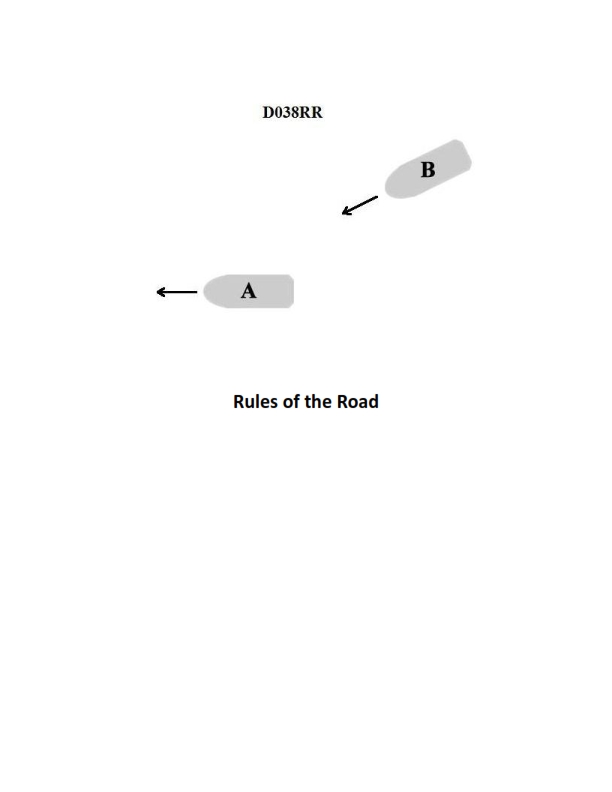
The Correct Answer is A ### Explanation for Option A (Hold course and speed) This scenario is governed by the Inland Rules of Navigation (specifically Rule 13: Overtaking and Rule 34: Maneuvering and Warning Signals). 1. **Status of Vessels:** Vessel "A" is the vessel being overtaken, and vessel "B" is the overtaking vessel. 2. **Responsibilities:** Under Rule 13(d), the vessel being overtaken (**Vessel A**) must maintain its course and speed until the other vessel has finally passed and is clear. The overtaking vessel (**Vessel B**) is responsible for keeping clear. 3. **Signal Exchange:** The rule states that the vessels have exchanged one blast signals. On inland waters, the one short blast signal from the overtaking vessel (B) means, "I intend to overtake you on your starboard side." The corresponding one short blast signal from the vessel being overtaken (A) confirms, "I agree to be overtaken on my starboard side." 4. **Action:** Once the agreement is made, Vessel A (the vessel being overtaken) is required to **hold course and speed** to allow the maneuver to be completed safely by Vessel B. ### Why Other Options Are Incorrect **B) Slow your vessel until vessel "B" has passed:** * **Incorrect:** Altering speed is a change of course or speed, which is strictly forbidden for the vessel being overtaken (Vessel A) under Rule 13(d). Changing speed unpredictably makes the overtaking maneuver more dangerous and difficult for Vessel B. **C) Alter course to the left:** * **Incorrect:** Altering course is a change of course or speed, which is strictly forbidden for the vessel being overtaken. Furthermore, altering course to the left (port) would bring Vessel A closer to Vessel B, potentially causing a collision, especially since B is passing on the starboard side. **D) Alter course to the left or right to give vessel "B" more sea room:** * **Incorrect:** Although the motivation might seem helpful, this action violates the cardinal rule that the vessel being overtaken must maintain course and speed. The responsibility of keeping clear and having sufficient sea room rests entirely on the overtaking vessel (Vessel B). Any unrequested or unannounced change in course by Vessel A creates confusion and danger.
Pass Your Coast Guard Licensing Exams!
Study offline, track your progress, and simulate real exams with the Coast Guard Exams app