Question 13 RVR05 - Master of LT 100 GRT
INLAND ONLY Two power-driven vessels are meeting in a narrow channel on the Great Lakes as shown in illustration D037RR below. Vessel "A" is downbound with a following current. Vessel "A" shall do which of the following?
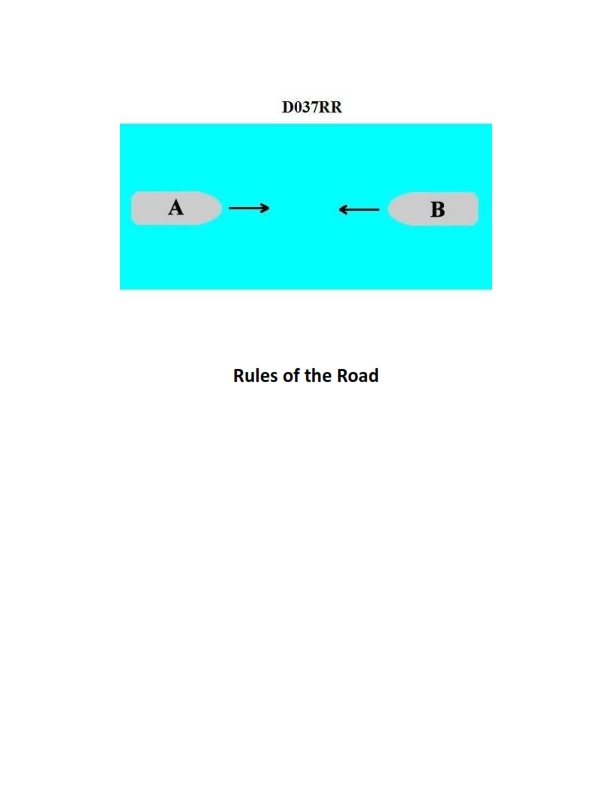
The Correct Answer is D **Explanation for Option D ("All of the above"):** The scenario describes two power-driven vessels meeting in a narrow channel on the Great Lakes, with Vessel "A" being **downbound** and having a **following current**. This situation is governed by the Inland Rules of the Road (specifically, Rule 9 - Narrow Channels, and specific rules relating to the Great Lakes and Western Rivers, though the core principles of meeting situations in channels apply). Under the Inland Rules, particularly in narrow channels: 1. **Vessel A Proposes the Manner of Passage (Option A):** When two vessels are meeting in a narrow channel, the vessel that is downbound with a following current (Vessel A) is generally considered to be less maneuverable and has the *right* to dictate the manner of passage. Rule 9(a)(ii) related to Great Lakes/Western Rivers operating procedures reinforces that the downbound vessel (A) proposes the manner of passage, usually by initiating the passing signal. 2. **Vessel A Initiates the Maneuvering Signals (Option B):** Since Vessel A proposes the manner of passage, it is required to initiate the signaling. The maneuvering signal (one short blast for port-to-port or two short blasts for starboard-to-starboard passage) announces its intent and proposes the maneuver to Vessel B. 3. **Vessel A Has the Right of Way (Option C):** Because Vessel A is downbound and has the current (making it harder to stop or hold position), it is granted the right of way over the upbound vessel (Vessel B) in a meeting situation within a narrow channel. Rule 9(a)(ii) (Inland) specifically grants this priority to the vessel proceeding with the current or downbound vessel. Since A, B, and C are all correct statements regarding Vessel A's responsibilities and privileges in this specific narrow channel situation, "All of the above" (D) is the correct answer. **Brief Explanation of why other options are incorrect (as standalone answers):** * **A) Propose the manner of passage:** This statement is correct, but it is incomplete. Vessel A has other duties and privileges (signaling, right of way) that are also true in this scenario. * **B) Initiate the maneuvering signals:** This statement is correct, but it is incomplete. Vessel A's role is broader than just initiating the signals; it also dictates the passage and holds the right of way. * **C) Have the right of way:** This statement is correct, but it is incomplete. The right of way is coupled with the requirement to propose the passage and initiate signals.
Pass Your Coast Guard Licensing Exams!
Study offline, track your progress, and simulate real exams with the Coast Guard Exams app