Question 38 RVR04 - Master or Mate of LT 200 GRT
INLAND ONLY You are on power-driven vessel "A" and power-driven vessel "B" desires to overtake you on the starboard side as shown in illustration D038RR below. After the vessels have exchanged one blast signals what action should you take?
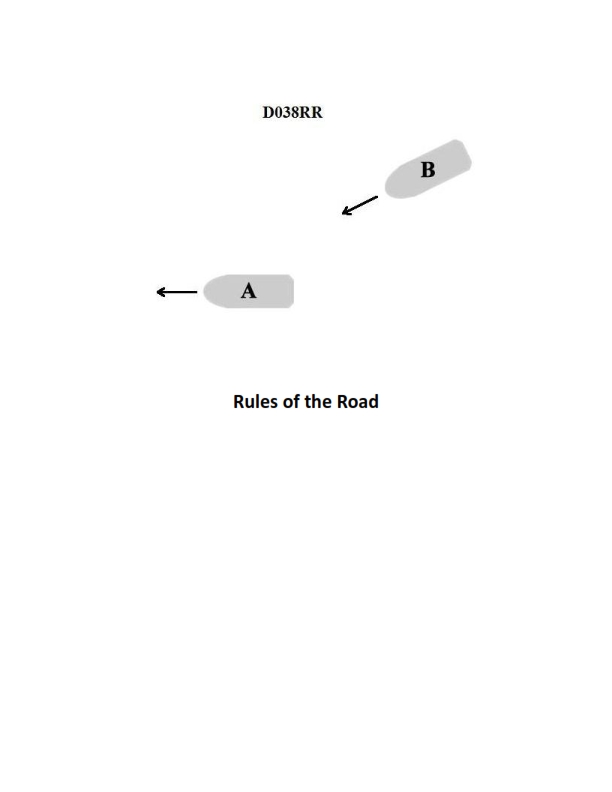
The Correct Answer is A ### Why Option A ("Hold course and speed") is correct: This scenario takes place under the Inland Rules (as indicated by "INLAND ONLY"). Rule 13 (Overtaking) dictates that the vessel being overtaken (vessel "A") is the Stand-on vessel and must maintain her course and speed. The vessel wishing to overtake (vessel "B") is the Give-way vessel and is responsible for keeping clear. In this case, vessel "B" has initiated the maneuver by proposing to pass on the starboard side (one short blast) and vessel "A" has consented by returning the same signal (one short blast). Once the agreement is made, the Stand-on vessel (A) must **hold course and speed** to ensure the maneuvering vessel (B) can safely execute the pass as planned. ### Why the other options are incorrect: **B) Slow your vessel until vessel "B" has passed:** This is incorrect because altering speed constitutes a change in the vessel's maneuver. The Stand-on vessel must maintain a steady course and speed unless the overtaking vessel is clearly unable to pass safely (which is not indicated here). Slowing down could complicate the passing maneuver for vessel "B" and violates the Stand-on vessel's duty. **C) Alter course to the left:** This is incorrect. Altering course violates the duty of the Stand-on vessel to maintain course and speed. Furthermore, altering course to the left (port) in this specific scenario would likely be dangerous, as it would turn vessel "A" directly into the path of vessel "B" which is passing to the starboard. **D) Alter course to the left or right to give vessel "B" more sea room:** This is incorrect. While the intent might be helpful, altering course is explicitly forbidden for the Stand-on vessel, as it removes the predictability necessary for the Give-way vessel (B) to plan and execute the maneuver safely. The Stand-on vessel must maintain course and speed.
Pass Your Coast Guard Licensing Exams!
Study offline, track your progress, and simulate real exams with the Coast Guard Exams app