Question 43 RVR03 - Mate of LT 500-1600 GRT
INLAND ONLY Two power-driven vessels are meeting in the situation as shown in illustration D037RR below and will pass within 1/2 mile of each other. What does two short blasts from either vessel mean?
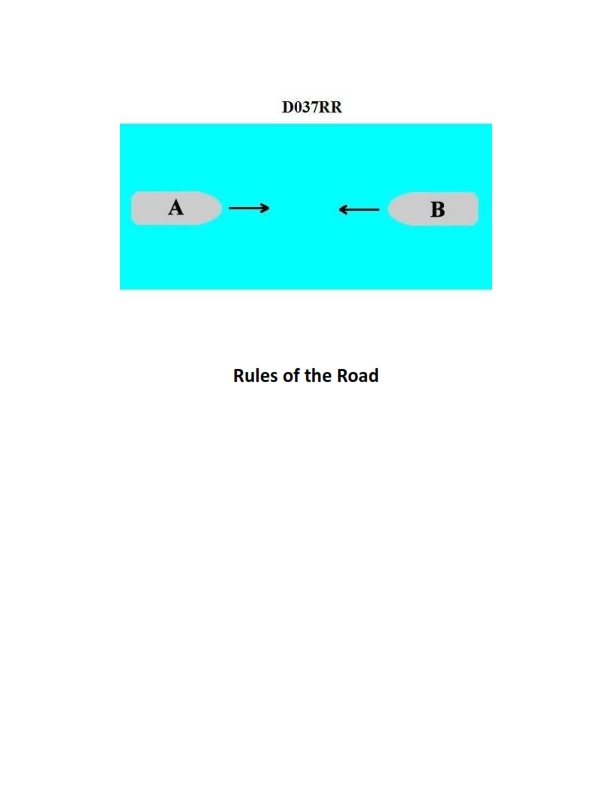
The Correct Answer is B **Why option B ("I intend to leave you on my starboard side.") is correct:** This question is specifically governed by the **Inland Rules of Navigation**. Inland Rule 34(a)(i) dictates the meaning of whistle signals when power-driven vessels are meeting or crossing within sight of one another. * One short blast means: "I intend to leave you on my port side" (or "I intend to pass port to port"). * **Two short blasts mean: "I intend to leave you on my starboard side" (or "I intend to pass starboard to starboard").** * Three short blasts mean: "I am operating astern propulsion." Therefore, two short blasts signal a definite intention by the signaling vessel to alter course (usually to port) in order to pass the other vessel on the side of the signaling vessel's own starboard. **Why the other options are incorrect:** * **A) "I am altering my course to port."** This is the action taken to achieve a starboard-to-starboard passing (leaving the other vessel on your starboard side), but the official meaning of the two-blast signal under the Inland Rules is the *intent* regarding the passing arrangement, not just the course change itself. A single short blast (altering course to starboard) signals the intent to leave the other vessel on your port side. * **C) "I intend to leave you on my port side."** This is the meaning of a **single** short blast under the Inland Rules (Rule 34(a)(i)). * **D) "I am altering my course to starboard."** This action is associated with a single short blast (Rule 34(a)(i)), which signals the intent to pass port-to-port.
Pass Your Coast Guard Licensing Exams!
Study offline, track your progress, and simulate real exams with the Coast Guard Exams app