Question 38 RVR03 - Mate of LT 500-1600 GRT
INLAND ONLY You are on power-driven vessel "A" and power-driven vessel "B" desires to overtake you on the starboard side as shown in illustration D038RR below. After the vessels have exchanged one blast signals what action should you take?
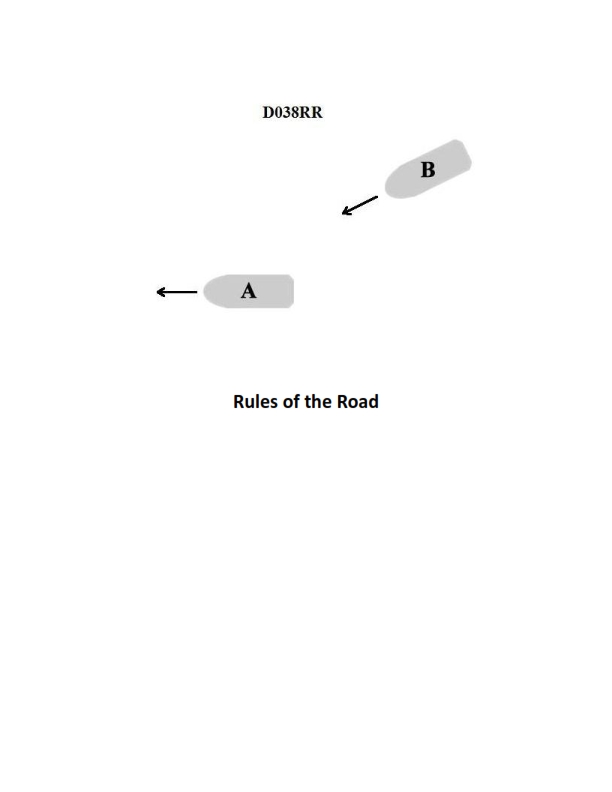
The Correct Answer is A. **Why Option A ("Hold course and speed") is correct:** This scenario involves overtaking on Inland Waters (U.S. Inland Rules of Navigation), where sound signals are mandatory for both initiating and agreeing to the maneuver. Vessel "A" is the vessel being overtaken, and vessel "B" wishes to overtake on the starboard side (one blast signal indicates the intention to overtake on the starboard side). Rule 13 (Overtaking) dictates that the vessel being overtaken (Vessel "A") must hold its course and speed. When Vessel "A" hears and agrees to the one blast signal from Vessel "B" (by repeating the one blast signal), Vessel "A" must facilitate the safe passage of the overtaking vessel by maintaining a predictable path. **Why the other options are incorrect:** * **B) Slow your vessel until vessel "B" has passed:** This is incorrect. The vessel being overtaken is required to maintain its speed and course. Slowing down could complicate the overtaking maneuver, especially if Vessel "B" has already factored Vessel "A's" current speed into its approach. * **C) Alter course to the left:** This is incorrect. The vessel being overtaken must maintain its course. Altering course (especially toward the overtaking vessel's path or the intended passing side) would violate Rule 13 and create a dangerous situation. * **D) Alter course to the left or right to give vessel "B" more sea room:** This is incorrect. While giving more room might seem helpful, the rules strictly prohibit the vessel being overtaken from altering course or speed. Predictability is paramount in this maneuver, and the responsibility for executing the safe maneuver rests primarily with the overtaking vessel (Vessel "B"). Vessel "A's" duty is passive: hold course and speed.
Pass Your Coast Guard Licensing Exams!
Study offline, track your progress, and simulate real exams with the Coast Guard Exams app