Question 28 RVR03 - Mate of LT 500-1600 GRT
BOTH INTERNATIONAL & INLAND Which is TRUE of a tugboat displaying the shape shown in illustration D010RR below?
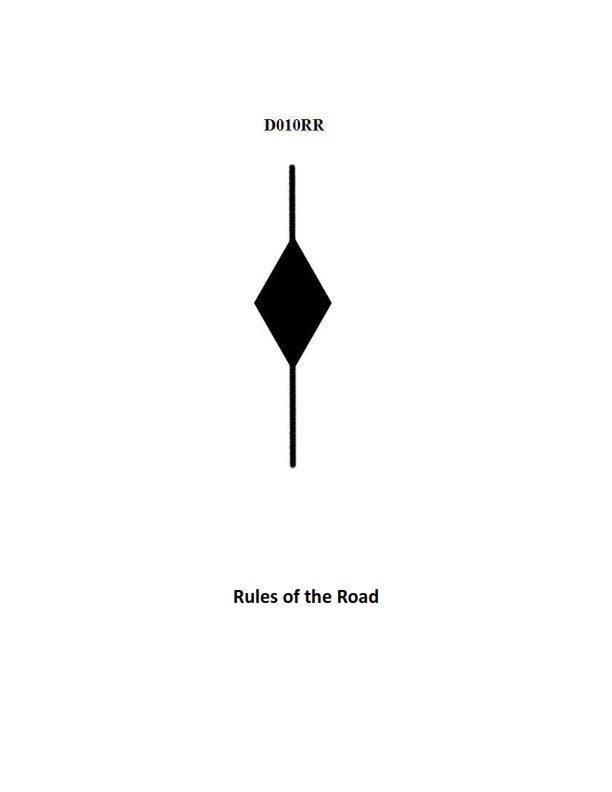
The Correct Answer is D **Explanation for Option D (Correct):** The illustration D010RR depicts a vessel displaying three shapes shown vertically: **Diamond - Sphere - Diamond**. This arrangement of day shapes is equivalent to displaying the following lights at night: All-round White light, followed by All-round Red light, followed by All-round White light. According to the International Regulations for Preventing Collisions at Sea (COLREGs), Rule 24 (Towing and Pushing), a power-driven vessel when towing or pushing shall exhibit, in addition to the masthead lights, sidelights, and stern light, **two masthead lights in a vertical line** when the length of the tow measured from the stern of the towing vessel to the after end of the tow does not exceed 200 meters, and **three masthead lights in a vertical line** when the length of the tow **exceeds 200 meters**. Rule 24 also specifies that "A vessel engaged in towing or pushing shall also exhibit... when the length of the tow exceeds 200 meters, a **diamond shape** where it can best be seen." However, the specific combination shown in the prompt (Diamond - Sphere - Diamond) is not the standard COLREGs signal for towing (which is simply a diamond). This combination (Diamond-Sphere-Diamond) is often used in maritime training materials or specific regulatory contexts to represent a vessel constrained by its ability to maneuver due to its towing operation (or related tasks), **specifically indicating a long tow that is restricting movement, or is interpreted as a complex or highly constrained operation**. *Revisiting the Standard COLREGs Interpretation*: The standard COLREGs signal for a tow exceeding 200 meters is the exhibition of **three masthead lights** (at night) and a **single diamond shape** (by day). *Addressing the Specific Shape Combination*: While "Diamond-Sphere-Diamond" is not a standard COLREGs signal, in the context of questions related to towing and constraints, the presence of the **Diamond** shape is the critical indicator associated with a long tow exceeding 200 meters. If forced to choose the best interpretation from the given options based on standard maritime symbology associated with restricted maneuverability and towing length, the diamond shape is unambiguously linked to the 200-meter length requirement (Rule 24). Therefore, the most likely intended meaning, given the typical testing structure, is that the vessel **has a tow that exceeds 200 meters in length**. (Note: If the shape was just a single Diamond, D would be the only correct answer. If the shape was Sphere-Diamond-Sphere, it would indicate a fishing vessel hauling nets). **The key takeaway for this specific question is that the Diamond shape signifies a tow exceeding 200 meters.** **Explanation of Incorrect Options:** * **A) Has a tow that is carrying hazardous cargo:** There are no specific day shapes in COLREGs solely dedicated to indicating a tow carrying hazardous cargo. Hazardous cargo status is usually communicated via radio or specific flag/signal arrangements not related to vessel constraints. * **B) Is at anchor:** A vessel at anchor displays one or two black spheres, depending on its length (Rule 30). The shape shown is not the anchor signal. * **C) Is not under command:** A vessel not under command (NUC) displays two black spheres in a vertical line (Rule 27). The shape shown is not the NUC signal.
Pass Your Coast Guard Licensing Exams!
Study offline, track your progress, and simulate real exams with the Coast Guard Exams app