Question 6 RVR02 - Master of LT 500-1600 GRT
BOTH INTERNATIONAL & INLAND Which of the following in illustration D086RR below represents the length of a vessel as defined by the Rules?
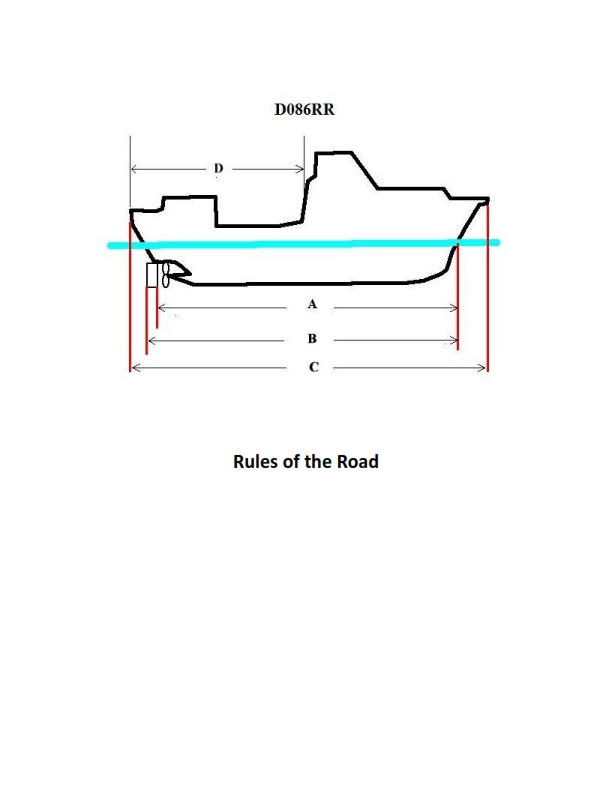
The Correct Answer is C. **Explanation for C being correct:** Option **C** represents the definition of a vessel's **length overall (LOA)**, which is the standard definition used when applying the International Regulations for Preventing Collisions at Sea (COLREGs) and Inland Rules. The length of a vessel, as defined by the Rules (specifically for lighting, shapes, sound signaling apparatus requirements, and maneuverability designations), is the length measured between the fore and aft extremities of the vessel, including all permanent structural parts (hull, bowsprits integral to the hull, etc.). Illustration C typically shows the maximum extent from the forwardmost point to the aftermost point. **Explanation for other options being incorrect:** * **A) A is incorrect:** Illustration A typically represents the vessel's length measured on the waterline (LWL), which is used for displacement calculations or hydrodynamics but is not the length used for the application of COLREG requirements (such as light visibility ranges or minimum vessel length thresholds for specific equipment). * **B) B is incorrect:** Illustration B typically represents the vessel's registered length or perhaps the length between perpendiculars (LBP), which measures the length of the hull itself, usually excluding parts like pulpits, rudders, or permanent fixtures extending beyond the main structure. This is used for naval architecture purposes but is not the overall length defined by the Rules. * **D) D is incorrect:** Illustration D typically represents the vessel's beam or breadth (the maximum width), which is a lateral measurement, not the longitudinal length required by the Rules.
Pass Your Coast Guard Licensing Exams!
Study offline, track your progress, and simulate real exams with the Coast Guard Exams app